|
|
|
|
|
HOME Online Since 1995
BUDDHISM & SHINTŌISM IN JAPAN
A-TO-Z PHOTO DICTIONARY OF
JAPANESE RELIGIOUS SCULPTURE & ART
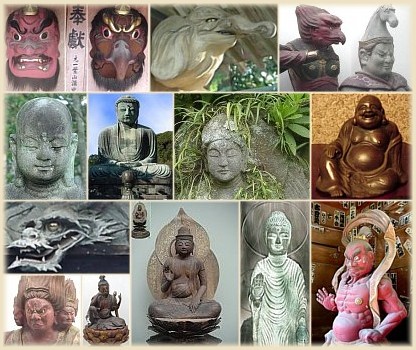
This photo library & dictionary is a labor of love. After moving to Japan in 1993, I became intrigued by the many deities & faces of Japanese Buddhism & Shintōism. There are dozens of Buddhist temples & Shintō shrines near my home in Kamakura, many dating from the 8th to 13th centuries, many open to the public. There are 400+ deities herein, & 4,000+ photos of statuary from Kamakura, Nara, Kyoto, & elsewhere in Japan. Use the search box to search in English, Japanese, Chinese, or Korean for deities not listed at left. Any mistakes or omissions at this site are my responsibility. Please contact me if you discover any. Sadly, our online statue store closed its doors in Dec. 2022.
|
|
|
IMPORTANT PRIVACY NOTE:
This is an open-access educational web site. This site
is safe, secure, and encrypted.
Your private data is not collected.

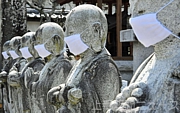
Japan's deities wear masks
to protect people from corona.
VIDEOS / INTERVIEWS
Video Archives ►
Interview (Aug. 2010) ►
|
  PREFACE PREFACE
My reasons for creating this photo dictionary are quite simple. First and foremost, this project is a labor of love. Second, it is a tribute to Kamakura, my home for the past 20 years, and home to dozens of temples from the Kamakura Era (1185-1333), which still house and display wondrous life-size wooden statues from the 8th century onward. Third, this project was prompted by a dissatisfaction with the online sites of the great repositories of Japanese Buddhist sculpture -- the national museums in Tokyo, Kyoto, and Nara. These sites don’t offer any systematic A-to-Z access to their impressive art collections. There is no comprehensive online catalog. Even so, the situation is much improved compared to only 15 years ago, thanks largely to advances in web technology. And to be fair, this is not just a problem with museums in Japan. At the online sites of major museums in America and Europe, it is likewise difficult to find what you want, even when you know the piece is in their collection.
Fourth, this project was prompted by a dissatisfaction with existing literature on Japanese Buddhist statuary. I still visit book stores and libraries hunting for “the perfect” English handbook on Japanese Buddhist sculpture. But I must admit, I have yet to find anything that satisfies me. Mountains of publications are out there. Many are aimed at the scholarly community, devoted to hyper-specialized topics, and extremely academic (thus "indecipherable" to the lay community). Another wellspring of information comes from museums, curators, art historians, and collectors. While lavishly illustrated exhibition catalogs and glossy art magazines are much appreciated and easier to read, these publications tend to ignore the religious underpinnings of Asian art. Instead of providing a broad historical view of the statue and its significance as a “living icon,” they tend to emphasize a piecemeal "bite-size" approach involving aesthetics, dating and provenance, technique, material, genre, and style. A third copious source of information comes from temples, practitioners, spiritualists, and independent web bloggers. Their publications are written for the general public but suffer from too much preaching, promoting, fabrication, self-interest, inconsistency, inaccuracy, and just plain "unreadability."
Don’t get me wrong. There are excellent resources (see bibliography) out there by scholars and art historians, but yet I'm unsatisfied. The best of the lot, in my mind, are the books entitled Sculpture of the Kamakura Period (by Hisashi Mori, 1974), Portraits of Chōgen: The Transformation of Buddhist Art in Early Medieval Japan (by John M. Rosenfield, 2010), and Faith and Power in Japanese Buddhist Art from 1600 to 2005 (by Patricia Graham, 2007). As for online resources, the Japanese Architecture and Art Net Users System (JAANUS) is by far the best digital dictionary devoted to Japanese art. It contains English definitions for over eight thousand Japanese terms related to religious sculpture, architecture and gardens, painting, ceramics, textiles, metalwork, and art-historical iconography. Another monumental work is the Digital Dictionary of Buddhism or DDB (log in with user name = guest). This online dictionary contains English definitions for over sixty thousand Chinese terms (as of May 2013), along with pronunciations in Chinese, Japanese, Korean, and Vietnamese. The DDB is also linked to the SAT Taishō Shinshū Daizōkyō (a digitized & searchable version of the Buddhist canon). Together they represent an invaluable reference work for Buddhist studies.
The study of Japanese religions and religious art has expanded greatly in the West over the past five decades. Until the 1960s, the field was populated mostly by college teachers and museum curators interested in collecting, but they had little or no training in Asian languages. Today the field is rooted firmly in Asian language sources and is highly specialized, with most universities emphasizing cult-specific, site-specific, ritual-specific, and deity-specific studies. These changes have deepened the discipline enormously, despite the tendency of hyper-specialization to narrow the outlook.
Thus I began in 1995 with my first digital camera, along with the help of my scanner. I’ve been digging around ever since. This site is my tribute to Japanese Buddhist sculpture and, to a lesser degree, Shintō art. It is written for scholars, art historians, practitioners, and laity alike, and attempts to remedy the dissatisfactions I mention above. Finally, let me express my gratitude and thanks to all the fine people, temples, shrines, museums, web sites, books, magazines, and other resources that have contributed to this ongoing project.
TIMELINE

TECHNICAL MATTERS
- Romanization. In most cases, this site uses the Hepburn system of romanization. Nonetheless, there is no fully satisfactory way of romanizing Japanese (or, for that matter, Chinese, Tibetan, Korean, or Sanskrit). To provide as much precision as possible, the Japanese ideograms (kanji) are presented, showing both the standard Japanese spelling and its hiragana equivalent.
- Japanese Names. Family names come before first names. Japanese do not have middle names.
- Deity Classification. Follows same scheme as that of the Japanese and their Buddhist scholars.
- Era Names & Dates. Standard dating scheme found in both Japan and the West.
 ABOUT SITE AUTHOR ABOUT SITE AUTHOR
- Mark Schumacher, Born 1959 (USA)
- B.A. Chinese Studies 1982, Hamline University, Minnesota
- M.A. Japanese Studies 1990, Johns Hopkins, SAIS, Wash. DC
- Resident of Japan since 1993
- Please click here for my resume
- Interview with site author in Japan Times, August 7, 2010
- Video. Site author explores Buddhist treasures in Ōita, April 16, 2013
- Please click here to email me
ABOUT SITE SOURCES
- Please see Bibliography for main resources
- Sanskrit, Pali, or Chinese documents are seldom used to construct these pages. Most information herein comes from primary resources from the Japanese tradition, temple visits, temple brochures, various dictionaries and guidebooks, museum publications (especially from Kyoto and Nara), and hundreds of web resources. I rely mainly on English and Japanese resources, but try to include Sanskrit, Chinese, and other spellings whenever possible for deity names, sutra titles, et. al. Credits for outside resources are listed above or below the text/image. Credits may also be viewed by holding the mouse momentarily over any specific image. About 50% of the photos are from outside sources, the rest are by me.
- I am not “fluent” in Chinese or Japanese, but studied both in undergraduate & graduate school, and attended language schools in both China & Japan. Even so, I struggle often with obscure Buddhist terms & historical references. When comparing different translations of the same sutra or reference work, I sometimes modify the translation to suit my own interpretation. Most of the translations at this site are not mine, however, and such translations are always identified in the credit.
CAVEATS, APOLOGIES, WHAT THIS SITE “IS NOT”
This site is about JAPANESE traditions in Buddhist sculpture and iconography. It is not a “Pan-Asian Iconographic Guide.” First, I am not qualified to discuss Buddhist artistic traditions in India, Tibet, and Mainland Asia. That topic is expansive, and would require the collaborative efforts of scholars and art lovers from many countries. So please bear this in mind as you read these pages. Although I often give the Hindu and Chinese spellings, and try to share Buddhist lore from the broader Asian tradition, this is just my way of “keeping notes” and learning myself about the outside influence of greater Asia on Japan’s Buddhist traditions. My experience with Buddhist art is largely confined to Japan, and I lack the resources to independently verify the spellings and lore from outside this island nation. So I apologize in advance for any factual errors that I may have introduced when talking about non-Japanese Buddhist traditions.
- Onmarkproductions.com is not associated with any educational institution, private corporation, governmental agency, or religious group. I am a single individual, working at my own pace, limited by my own inadequacies. No one is looking over my shoulder, so I must accept full responsibility for any and all inaccuracies at this site. If you discover any, please contact me directly.
- Buddhist-Artwork.com, our sister site & eStore, launched in July 2006. It sells quality hand-carved wood Buddha statues & Bodhisattva statues, especially those carved for the Japanese market. Aimed at art lovers, Buddhist practitioners, and laity alike, the estore is not associated with any educational institution, private corporation, governmental agency, or religious group.
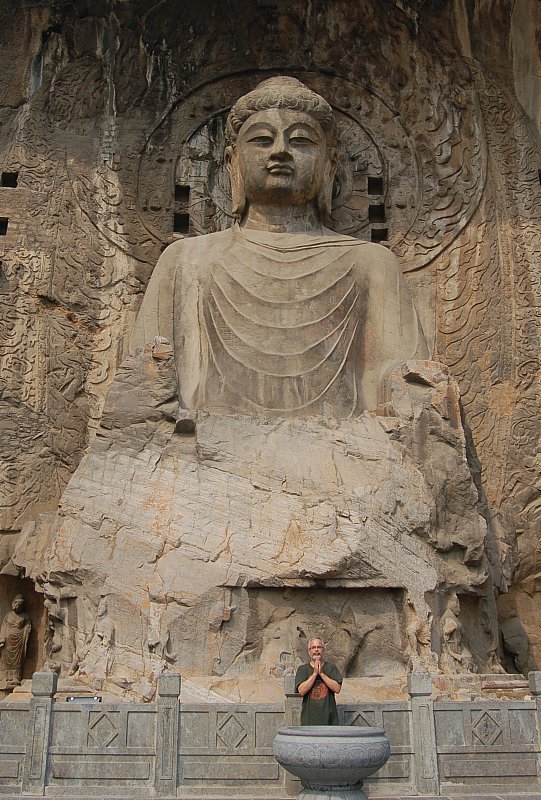
Site Author Mark Schumacher at Fengxian Temple, China (World Heritage Site)
See Photo Tour of the Longmen Caves Here (September 2008)
Fengxian Temple 奉先寺, Ancestor Worshipping Temple. Carving began in 672, completed circa 672-675 AD
Central Image = Vairocana Buddha (Jp. = Dainichi Nyorai), Seated atop lotus; 17 meters in height; limestone.
Commissioned by Empress Wu Zetian, and reportedly made to resemble her facial features.
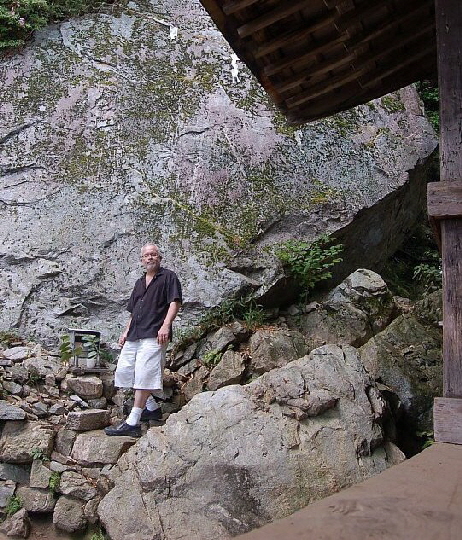
Site author at Hiezan's Golden Rock 金大巌 (abode of two of Japan's oldest & most powerful kami).
May 2012. Since there was no one but me on the mountain path this day, I took this photo using my
camera's auto-shoot feature -- I had to balance the camera atop a rock to get the right angle.
The rock deities of the mountain welcomed me. I have always loved stones..........
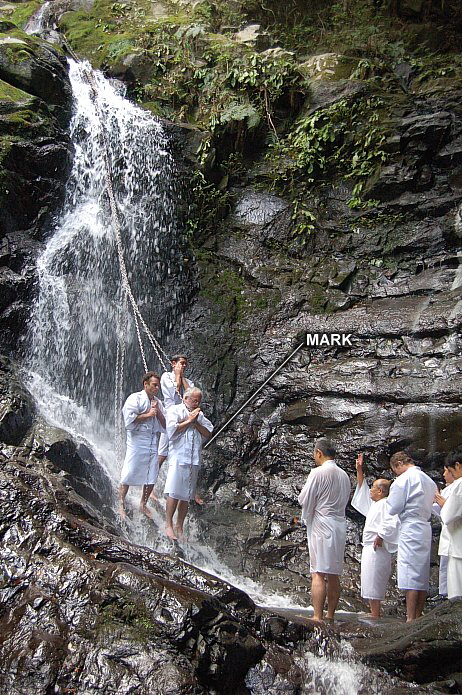
Site author undergoing purification ritual at Mt. Inunaki 犬鳴山, a Shugendō site. June 2011.
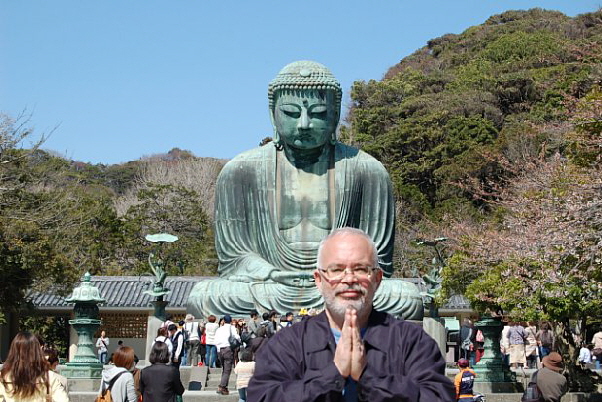
Big Buddha of Kamakura -- Amida Nyorai -- along with site author Mark Schumacher. March 2013.
The giant bronze statue of Amida, cast in 1252, is roughly 11.3 meters in height (without pedestal).
|
|







