|
OVERVIEW:
History & Timeline of Buddhism’s Spread
Before Reaching Japan
Overview  | Hinduism | Theravada | Mahayana | Vajrayana | Early Rifts | Comparing Schools | Hinduism | Theravada | Mahayana | Vajrayana | Early Rifts | Comparing Schools
After Arriving in Japan
Buddhism Arrives Japan | Six Schools of Nara | Guide to Buddhism in Japan
Korean Influence | Confucianism in Japan | Taoism in Japan | Shintoism in Japan
THREE SCHOOLS OF BUDDHISM. Introduced in India around 500 BC by Gautama, Buddhism swept quickly (some 1000 years) across Asia, splitting into three main schools (Theravada, Mahayana, Vajrayana) as it evolved. In India, its birthplace, Buddhism died out around 1200 AD, succumbing to Muslim invasions and resurgent Hinduism. But by then it was flourishing in Southeast Asia, Tibet, China, Korea, and Japan -- it came last to Japan, crossing the sea around 520 - 550 AD. Although the Japanese court was quick to adopt Mahayana Buddhism, the teachings of the Theravada and the Vajrayana (Tantric or Esoteric) schools did not go unnoticed or unpracticed. Sects from all three schools are still active in Japan today, but the dominant form is clearly Mahayana. This is especially true when talking about Buddhist sculpture and art. Many of Japan’s Buddhist treasures still survive and are available for firsthand inspection at temples in Nara, Kyoto, Kamakura, and elsewhere. In large part, this artistic legacy tells the story of Mahayana Buddhism. Also, unlike the rigid atheism of Theravada Buddhism (which reveres the Historical Buddha but ignores all other deities), the Mahayana and Vajrayana schools brought with them a large number of Hindu deities (see TENBU) who were adopted into Japan’s Buddhist pantheon. Buddhism in Japan subsequently developed along an extremely syncretic path, mixing together Hindu, Buddhist, and Shintō (kami cult) elements along with influences from Taoism, Confucianism, yin yang theories, zodiac cosmology, star worship, mountain asceticism, shamanism, nature cults, and animism.
AXIAL AGE. Buddhism emerged in the so-called Axial Age (from 800 BC to 200 BC), when the religious foundations of much of the world appeared simultaneously yet independently, including Judaism, Jainism, Buddhism, Confucianism, Taoism, Platoism, and other major faith systems. In China, Buddha’s contemporaries were Confucius and Lao-tzu (the founder and “old boy” of Chinese Taoism), and slightly later in the West comes Plato (approx. 427 - 347 BC).
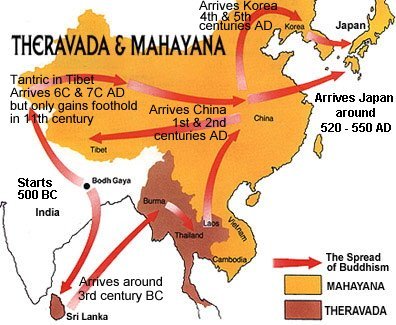
Map courtesy of Buddhanet

Buddhism as practiced today is still divided into these three schools -- (1) Theravada, meaning School of the Elders, but pejoratively known as Hinayana or Lesser Vehicle; (2) Mahayana, meaning Greater Vehicle; and (3) Vajrayana, meaning Diamond Vehicle; also known as Tantric or Esoteric Buddhism. “Yana” is the Sanskrit term for vehicle. The bewildering number of sects are categorized into one of the three schools.
- Theravada (Hinayana)
Found mainly in Sri Lanka, Burma, Cambodia, Laos, and Thailand. Often known as the Southern Traditions of Buddhism.
- Mahayana
Found mainly in China, Korea, Vietnam, and Japan. Often known as the Northern Traditions of Buddhism.
- Vajrayana (Esoteric or Tantric Buddhism)
Practiced mainly in Tibet, Nepal, and Mongolia, but in Japan has a strong hold with the Shingon 真言, Tendai 天台, and Shugendō 修験道 sects. In Japan, Esoteric Buddhism is known as Mikkyō (Mikkyo) 密教). Along with Mahayana Buddhism, the Vajrayana traditions are often referred to as the Northern Traditions of Buddhism.
OUTSIDE LINKS - TIMELINE OF BUDDHISM
Timeline #1 - Metropolitan Museum of Art (New York)
Overview of Art History in Japan
Timeline #2 - Pacific Asia Museum (need Flash)
Launch site, click “The Perfected One,”
then click the Timeline & Map button.
RELIGIOUS & PHILOSOPHICAL INFLUENCES ON JAPANESE BUDDHISM
|





