|
|
|
|
Shōtoku Taishi 聖徳太子
Chn.= Shànggōng; Korean = Sanggung 상궁
Prince Shōtoku Taishi
First Great Patron of Buddhism in Japan
Imperial Regent of Japan in Early 7th Century
聖徳 = Divine Virtue; 太子 = Taishi = Crown Prince or Statesman
INTRODUCTION. Buddhism originated in India around 500 BC and swept across Asia in just 1000 years. It came last to Japan, crossing the sea in the mid 6th century, first from Korea and then later from China. Buddhism was greeted with some resistance in Japan (see Early Japanese Buddhism), but by + 585 it was recognized by Emperor Yōmei 用明 (reigned + 585-587) and thereafter spread fast under the patronage of his second son, Shōtoku Taishi 聖徳太子 (+ 574-622).
Tradition holds that Emperor Yōmei (also spelled Yomei, Youmei) once experienced a serious illness, but the young Shōtoku, impressed by the new Buddhist faith, prayed day and night by his father’s side. Emperor Yōmei recovered and converted to Buddhism.
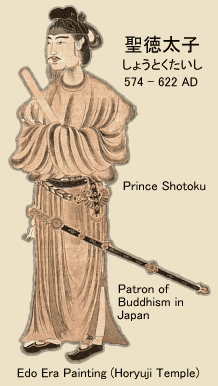
In the years thereafter, Shōtoku renounced any claim to the throne and pledged to devote his life to public duty. For the next three decades -- during the reign of his aunt Empress Suiko 推古 (reigned + 592 to 628), a member of the powerful Soga 蘇我 clan -- he served as prince regent and the foremost proponent of the new Buddhist teachings. Many statues and paintings of the prince were created in the centuries after his death.
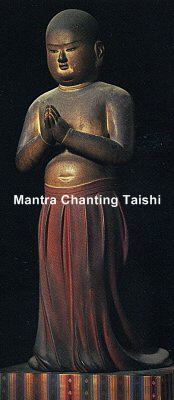
Legends about Prince Shōtoku are riddled with folklore -- many miraculous tales were created in the coming centuries. Although most contain some element of truth, others have been debunked by modern researchers. According to one legend from the eighth-century Nihon Shoki (one of Japan's oldest texts, complied in the early eighth century), his virgin mother bore him "unexpectedly" while on her routine inspection of the imperial horse stables. A common medieval depiction of the prince shows him at age two with palms together praying to Buddha. This form is known as Namubutsu Taishi ( Mantra-Chanting Taishi). < Sources
For Shotoku's sudden-painless birth at horse stable, see Nihon Shoki (Suiko 1.4.10), compiled in the early eighth century. For virgin birth, see opening pages of the tenth-century (917) text Shotoku Taishi Denryaku. For a brief English overview, see Lori R. Meeks's In Her Likeness, pp. 368-369, Japanese Journal of Religious Studies, Vol. 34, No. 2, 2007. Read online at nirc.nanzan-u.ac.jp/nfile/2933. Two of the oldest extant wooden statues of the Mantra-Chanting Taishi are at the Fogg Art Museum (ca. 1292) in Massachusetts and Horyuji Temple (1307) in Nara.
> Some Japanese and foreign scholars claim that Shōtoku legends are fabricated. New Japanese high-school textbooks to be issued in 2014 are throwing into question the existence of Prince Shōtoku. See Asahi Shimbun article, March 27, 2013.
Other Japanese Names for Prince Shōtoku
Umayado 厩戸皇子 ・ Umayado no Ōji 厩戸皇子王子 (Prince of the Stable Door); Toyosatomimi 豊聡耳 ・ Kamitsumiyaō 上宮王 ・ Kamitsumiya no Umayado no Toyosatomimi no Mikoto 上宮之厩戸豊聡耳命 ・ Umayato Toyotomimi Taishi 上宮厩戸豊聡耳太子 ・ Jōgū 上宮 ・ Jōgū Taishi 上宮太子 ・ Jōgūō 上宮王 (King Jōgū) ・ Jōgū Hōō 上宮法皇 (Dharma Emperor) ・ Jōgū Hōō 上宮法王 (Dharma King) ・ Jōgū-ō Taishi 上宮皇太子. Jōgū (literally "upper palace") refers to an elevated chamber inside the imperial palace of Emperor Yōmei. Shōtoku was Yōmei's second son and reportedly lived in this elevated chamber. OTHERS: 豊耳聡聖徳, 豊聡耳法大王, 法主王

Shōtoku Taishi (574 - 622)
Shōtoku (also spelled Shoutoku, Shotoku) embraced the new faith and was one of its first converts. He fostered its acceptance as both a superior religious philosophy and a powerful political tool for creating strong centralized governance under the emperor’s guidance. Ironically, the pro-Buddhist Soga 蘇我 clan, which the prince supported, would later try to usurp (unsuccessfully) the power of the throne. Shōtoku is credited with constructing numerous temples, including the famous Hōryūji Temple 法隆寺 in Nara (see below) and Shitennō-ji Temple 四天王寺 in Osaka (see below), and with centralizing state administration, importing Chinese bureaucracy, codifying twelve court ranks, and enacting a 17 Article constitution that established Buddhist ethics and Confucian ideals as the moral foundations of the young Japanese nation. During his regency, Japanese missions (outside link) were dispatched to China.
|
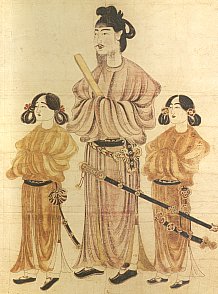
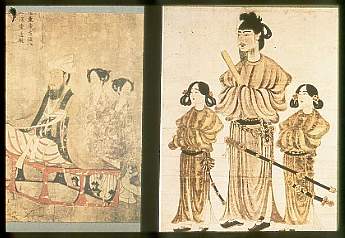
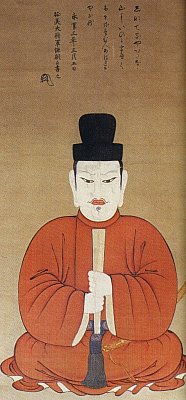
Karahon no Miei = 唐本御影
Chinese-style Portrait of a Nobleman
Nara Era Painting (8th C) in the
Imperial Household Collection
H 101.3 cm X W 52.5 cm
Oldest extant painting of
Sesshō Taishi 摂政太子,
literally “Regent Taishi.” Scepter in hand
Flanked by younger brother (L = Eguri 殖栗)
and 1st son (R = Yamashiro 山背)
|
|
 The transition to Buddhism was not always peaceful. In Prince Shōtoku's time, it had sparked a feud between pro-Shinto factions (Mononobe clan 物部) and pro-Buddhist forces (Soga clan 蘇我), one in which the young prince reportedly fought. Ironically, the pro-Buddhist Soga clan that Prince Shōtoku supported (he was a member of that clan, which defeated the Mononobe) would in the next few decades usurp the power of the throne, force Shōtoku's heir to commit suicide (thus ending the prince’s line), and ultimately be destroyed themselves in a coup led by the imperial family. The prince never became a monk, but in modern popular belief he is revered as a Buddhist saint, and in some traditions he is considered the reincarnation of Kannon 観音 or Shaka 釈迦 (the Historical Buddha). He is also, in Japan, closely associated with Daruma, the founder of Zen Buddhism. After Shōtoku’s death, portraits of the prince began appearing in small number. See painting at right, which is the oldest extant painting in Japan. Noted art scholar Ernest F. Fenollosa (+1853 - 1908) attributes this piece to the Korean Prince Asa, a contemporary of Prince Shōtoku, but modern scholars date it to the early 8th century. By the late 11th century, however, paintings and sculptures of the beloved prince occur in vast number, and many are still extant. Indeed, artwork of the prince is perhaps more abundant than artwork of all other real-life figures from Japan, with the possible exception of Kōbō Daishi 弘法大師 (+774 - 835), the founder of Japan’s esoteric Shingon 真言 sect of Buddhism.
KOREAN INFLUENCE IN JAPAN
Prince Shōtoku lived at a time when Korean influence was perhaps near its peak in Japan. Immigration from both Korea and China can be traced back to at least the mid-third century. By Shōtoku’s time, many of Japan’s highest ranking monks and artisans hailed from Korea. These immigrants from Korea played instrumental roles in transmitting the Buddhist teachings and art techniques to the Japanese court, its court-sponsored art workshops, and the newly established temples that served as Japan’s main centers of Buddhist study. The Koreans themselves had received the Buddhist tradition via China, and had adopted many of China’s techniques for carving in wood, for making gilt bronze statues, and for reproducing Buddhist icons in vast number. See Making Buddha Statues for many more details.
Prince Shōtoku learned about Buddhism, it is said, mainly from two Korean monks. One hailed from the Korean Kingdom of Koguryo 高句麗 (Goguryeo), and was named Eji 慧慈 (えじ). The other hailed from the Korean Kingdom of Kudara 百済 (Paekche), and was named Esou 慧聡 (Esō えそう). Korean artisans played an important role in temple construction. The famous Hōryūji Temple in Nara, the main center of worship for Shōtoku’s family, was first built in +607 by artisans from Korea's Paekche 百済 kingdom. Two other temples closely associated with Prince Shōtoku -- Hōrin-ji 法輪寺 or 法琳寺 and Hōkiji 法起寺 -- were most likely built by artisans of Korea's Paekche kingdom as well. For more on these temples, see below.
Shōtoku also maintained strong relations with many immigrants from mainland Asia who had made their way to Japan along the silk roads. See HATA section below for more details. (Editor’s Note: To people traveling east along the silk roads, Japan’s Naniwa and Nara areas were the eastern terminus. Conversely, for Japanese people traveling west, Naniwa or modern-day Osaka was considered the gateway to Korea, China, and greater Asia.)
However, by the early 8th century, the Korean artistic influence began to wan, and was eventually overshadowed by Japan's growing fascination with China and Chinese Tang-era culture. Prince Shōtoku, nonetheless, lived during a period when the Korean influence was perhaps stronger than the Chinese. Elsewhere, the influx of Korean and Chinese emissaries brought with them the Chinese written and spoken language, which remained the de facto language of the young Japanese nation until the 9th century. Prince Shōtoku was also apparently good friends with Korean Prince Asa, a contemporary of his. For more on Korea’s strong early influence in Japan, please visit the KOREAN INFLUENCE ON JAPANESE BUDDHIST ART page.
HATA INFLUENCE IN JAPAN
Another interesting issue involves the Hata 秦 people, immigrants from central Asia (as far west as Assyria) who traveled along the silk road, and finally made their way to Japan via Korea and China in the 4th century, bringing their Christian faith as well. Says author Ken Joseph Jr., in his book LOST IDENTITY: “The Hata tribe came from an area in central Asia designated in Chinese by the characters 弓月, pronounced in Japanese as "Yuzuki" and in Chinese as "Gong-Yue." It was located along one route of the Silk Road just south of Lake Balkhash along the Ili River. According to Japan’s Nihon Shoki (Chronicles of Japan, compiled around + 720), Yuzuki no Kimi 弓月君 (the Lord of Yuzuki), crossed over to Japan from the Korean state of Paekche around 400 AD, arriving first in Hyougo Prefecture. He made a very favorable impression on Emperor Oujin and the emperor granted him and a large number of fellow immigrants tracks of land in Yamato Province (what is now Nara Prefecture). This was the beginning of the Hata clan in Japan.”
Among Shōtoku’s advisors was Hatano Kawakatsu (秦河勝), the leader of the Hata 秦 clan. Hatano was, by many accounts, an important counselor to Prince Shōtoku. Shōtoku’s son, Yamashiro no Ōe no Ō 山背大兄王, took his name from the Yamashiro region in southern Kyoto where the Hata 秦 clan was established. This suggests that Shōtoku most likely maintained strong relations with this immigrant community.
Author Ken Joseph Jr. presents a compelling case that Prince Shōtoku was greatly influenced by Hata 秦 immigrants from central Asia. These Hata immigrants allegedly brought belief in Keikyo 景教 (early Christianity from central Asia, including Nestorianism) to Japan. The author argues that Shōtoku legends and extant artwork of the prince are mixed heavily with Christian influences, that competing interests at court led to the death of Shōtoku’s entire family, and that Shōtoku’s legend as Japan’s Great Patron of Buddhism in Japan is a fabrication concocted by the victors to appease the spirit of the dead Shōtoku and to quickly advance their goal of using Buddhism as a tool of state control. Many modern Japanese scholars have reached similar conclusions, pointing to the mystery surrounding the famous statue of Guze Kannon at Hōryūji Temple. Reportedly made in the image of Prince Shōtoku, the statue remained hidden from view for centuries, until it was finally unveiled in +1884. The halo of the statue was attached to the head by a large nail, a very unusual method. Scholars argue it was a voodoo-like technique to subdue the spirit of the wronged Prince Shōtoku. See Guze Kannon below or jump to overview of Ken Joseph’s book.
|
IMPERIAL LINEAGE
|
|
(L) Chinese portrait (R) Shōtoku’s portrait
The model for the portrait of Prince Shōtoku came from China, where emperors were often shown in similar poses. This emphasizes the imperial lineage of Shōtoku, who was born in + 574 as the second son of Emperor Yōmei 用明.
Says Henry Smith, Columbia University: “The image of Prince Shotoku as a Confucian statesman is seen best in this portrait, the model for the ten thousand yen note. He is accompanied by his younger brother on the left and his eldest son on the right. He is in Chinese-style court dress, from the official hat down to the curly-toed aristocratic shoes. The wooden paddle in his hands was originally a kind of crib sheet for following complex court rituals, but in this highly idealized portrait it is simply a symbol of bureaucratic status. The Prince’s long and ornately jeweled sword also suggests political power. Although he was renowned as a man of peace, in other words, Prince Shotoku could not be disassociated from the aura of the militaristic society into which he was born.”
Photo & Text Courtesy Henry Smith, Columbia University. Please visit above link for a wonderful slideshow about the making of Hōryūji Temple, a temple of long importance to Shōoku’s memory. .
|
|
Artwork of Prince Shōtoku -- Four Major Categories
Below Text Courtesy of JAANUS. See JAANUS for more details
- Mantra Chanting (Nanbutsu Taishizou 南無仏太子像). See photo below.
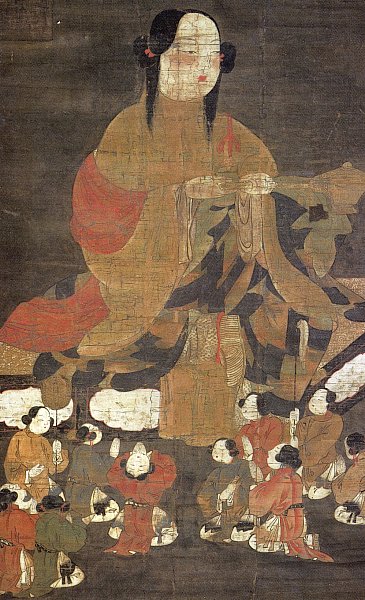
- Offering Filial Piety (Kouyou Taishizou 孝養太子像). These images depict him holding a scepter, along with a censer. The scepter represents secular authority, while the censer represents spiritual pursuits. This type of art relates to the young Shoutoku praying for the recovery of his ill father, Emperor Youmei. See photo below.
- Lecturing on the Sutra (Kousan Taishizou 講賛太子像)
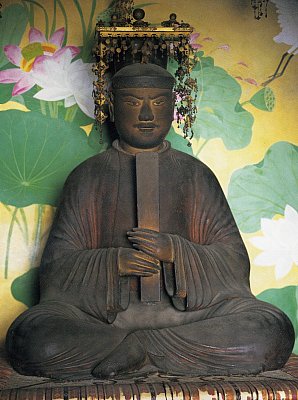
- Regent Taishi (Sesshou Taishizou 摂政太子像). The oldest known Sesshou Taishi image is a painting from the early Nara period (8c) in the Imperial Household Collection, which is traditionally called the "Chinese Style Portrait of a Nobleman" (Karahon no Miei 唐本御影). Shoutoku stands with scepter in hand, flanked on each side by the smaller princes Yamashiro 山背 and Eguri 殖栗. (See photo near top of this page). The earliest extant sculpture of Sesshou Taishi is from the Shōryōin 聖霊院 at Hōryūji (1121 AD). In this work, the prince is seated, flanked by four accompanying figures. See photo below.
- Many of the earliest legends concerning Prince Regent Shoutoku appear in the SHOUTOKU TAISHI DENRYAKU 聖徳太子伝略. As to artwork of the prince, Henry Smith of Columbia University writes: “Most depictions of Prince Shōtoku are highly idealized, done many years after his lifetime. In fact, all of the little that we know about him is based on records compiled long after his death, when he was already a legend.” SOURCE: See JAANUS Entry on Shōtoku Art for many more details.
|
|
PHOTO DESCRIPTION
Kōyō Taishizō 孝養太子像 - Shotoku Offering Filial Piety. 11th Century, Painting, 128.8 cm x 75.8 cm. Treasure of Ichijouji Temple 一乗寺 in Hyogo 兵庫 Prefecture
SAYS JAANUS:
Oldest known Kōyō Taishi is a painting from the set of portraits of Tendai monks at Ichijōji Temple 一乗寺 in Hyōgo Prefecture. Shoutoku is shown seated cross-legged on a low dais wearing a monastic surplice (kesa 袈裟) and holding a long-handled incense burner. Inscriptions on the Ichijouji set suggest that the paintings were patterned after wall-painting produced before + 946 at Enryakuji Temple 延暦寺 on Mt. Hiei 比叡. The inclusion of Shōtoku in the set is based on the acceptance of the prince as an incarnation of the second Tendai patriarch Huisi 慧思 (Jp: Eshi, + 515 - 577).
|
|
|
|
|

|
|
|
|
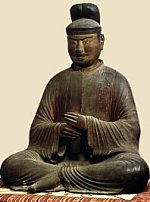
Regent Shōtoku Taishi, Sesshō Taishizō
Treasure of Horyuji Temple, Nara
Dated 1121, Wood with Color, H = 84.2 cm
Considered the earliest extant sculpture of Sesshou Taishi
The scepter in hands represents secular authority.
Flanked by four accompanying figures (not shown above)
|
2-Year-Old Shōtoku Taishi
Mantra Chanting (Nanbutsu Taishizō 南無仏太子像).
Dated 1304, Wood, H = 70.5 cm. Denkōji Temple 伝香寺 in Nara. Apparently now in the keeping of Hōryūji Temple 法隆寺 in Nara. One of the oldest extant wood Nanbutsu Taishi statues. Another is located at Fogg Art Museum (1292).
|
|
NOTE on above photo of 2-year-old Shōtoku Taishi. Says JAANUS: (Nambutsu Taishizou 南無仏太子 depict the prince at the age of two when, on the 15th day of the Second month, he reputedly faced east, placed his palms together, and recited the nambutsu, a prayer honoring the Buddha's name and calling up his grace. <end JAANUS quote> This is reminiscent of the legend about the birth of the Historical Buddha. Click here to read about this legend.
|
|
|
|
|
|
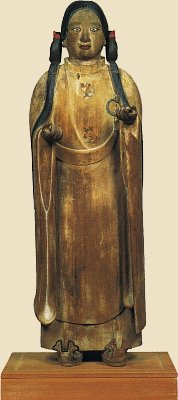
Young Taishi, Dōgyō Taishi 童形
14th Century, Wood with Color, H = 117 cm
Jōfukuji Temple 定福寺, Kochi 高知 Prefecture
|
Regent Shōtoku Taishi, Sesshō Taishizō
Treasure of Daruma-ji Temple, Nara
Year + 1431, Painting, H = 171.2 cm x 81.3 cm
The scepter in hands represents secular authority.
|
|
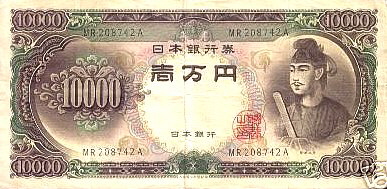
10,000 Yen Japanese Currency
No longer in circulation. Discontinued in mid-1980s
Until the mid-1980s, portraits of Prince Shōtoku
appeared on various Japanese monetary notes.
|
RIDDLES UNSOLVED
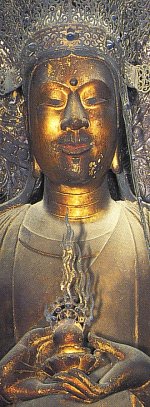
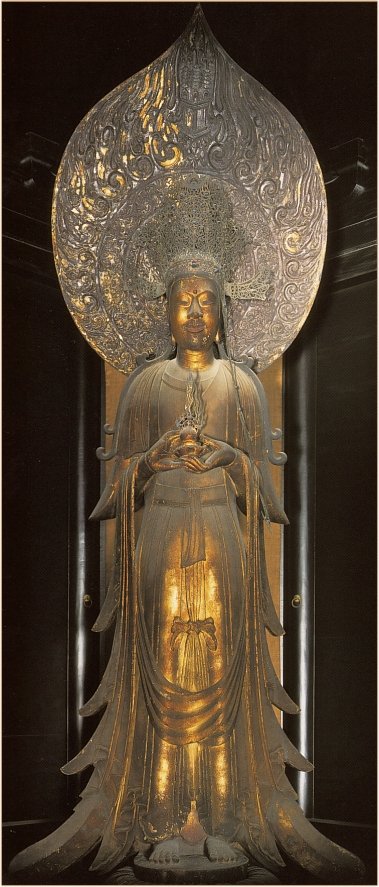
Guze Kannon 救世観音 (Guse, Kuze, Kuse)
Also called Yumedono Kannon 夢殿観音
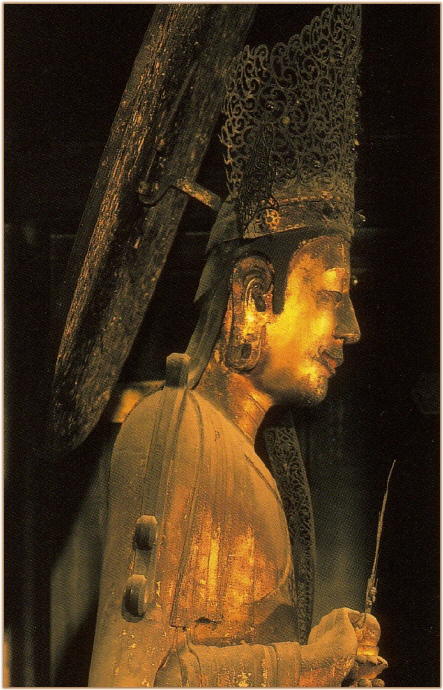
Reportedly made in the image of Prince Shōtoku
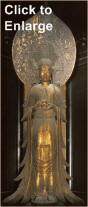 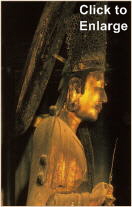
Hōryūji (Horuyji) Temple 法隆寺, Nara, 620 AD or so
7th Century, Height = 178.8 cm
Made from a single block of wood
= Camphor (Kusu 樟)
Gold leaf (hakuoshi 箔押) applied over surface,
and coronet and other details made from gilt bronze.
This is the earliest extant wooden statue in Japan (first half 7th century). Carved from one piece of camphor 樟 wood, in the style of those times. Gold leaf is applied over the surface, and the coronet and other details are made from gilt bronze. The effigy is the non-esoteric form of Shō Kannon, as Esoteric Buddhism (Mikkyō 密教) did not arrive in Japan until the 9th century. Guze is also a name used for sculptures of the Asuka period, specifically for sculptures of a crowned Bodhisattva (Bosatsu) holding a jewel. Scholars believe this statue was made in the image of Prince Shōtoku. Statues at Sanzen'in Temple 三千院 in Kyoto and Shitennōji Temple 四天王寺 in Osaka have also traditionally been called Guze Kannon, but they differ from the Yumedono statue (statue shown in above photos) at Hōryūji Temple in that they are seated images (hankazō 半跏像) and deviate from the normal forms of Shō Kannon statues.
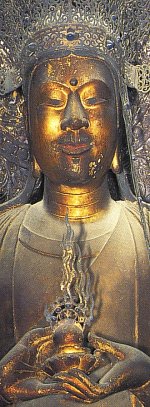  The Guze Kannon at Hōryūji was kept hidden for centuries inside the temple’s Yumedono Hall 夢殿 (hence the statue is also known as the Yumedono Kannon). Even the priests were forbidden from viewing the statue, which was wrapped in white cloth. The practice of maintaining Secret Buddha (Jp. = Hibutsu 秘仏) most likely originated among Japan’s esoteric sects (Shingon & Tendai) during the Heian period. The statue was finally unveiled in 1884, when the Japanese government allowed Ernest Fenollosa (+ 1853-1908) and Okakura Tenshin 岡倉天心 (+ 1863-1913) to discover its secrets. Fenollosa thought it to be of Korean origin, but no concensus was ever reached. Some think it displays the style of Japan’s Tori Busshi school of Buddhist sculptors. Today it is considered to be one of Japan's greatest art treasures. It still remains a Hibutsu at the temple, but for a small time every spring and fall it is open for viewing. < See JAANUS for more details on Guze Kannon > The Guze Kannon at Hōryūji was kept hidden for centuries inside the temple’s Yumedono Hall 夢殿 (hence the statue is also known as the Yumedono Kannon). Even the priests were forbidden from viewing the statue, which was wrapped in white cloth. The practice of maintaining Secret Buddha (Jp. = Hibutsu 秘仏) most likely originated among Japan’s esoteric sects (Shingon & Tendai) during the Heian period. The statue was finally unveiled in 1884, when the Japanese government allowed Ernest Fenollosa (+ 1853-1908) and Okakura Tenshin 岡倉天心 (+ 1863-1913) to discover its secrets. Fenollosa thought it to be of Korean origin, but no concensus was ever reached. Some think it displays the style of Japan’s Tori Busshi school of Buddhist sculptors. Today it is considered to be one of Japan's greatest art treasures. It still remains a Hibutsu at the temple, but for a small time every spring and fall it is open for viewing. < See JAANUS for more details on Guze Kannon >
GUZE KANNON MYSTERY?
Below text by Henry Smith, Columbia University
“Prince Shōtoku’s Temple, The Riddles of Hōryūji”
Editor’s Note: A wonderful presentation, highly recommended.
Prince Shōtoku was, after all, like Shakyamuni (the Historical Buddha), a royal prince who renounced his inheritance in pursuit of spiritual ideals. Following Shōtoku's death in + 622, his family continued to patronize Hōryūji Temple until 643, when his son and heir, Prince Yamashiro, was forced to commit suicide by the Soga clan leader, who was fearful of the threat that Yamashiro posed to Soga power. With this, the direct line of Prince Shōtoku came to an end. The temple survivied, however, in close association with the memory of Shōtoku.
But as far as we can tell, the Yumedono Kannon was never seen by anyone from the time of its consecration in the eighth century until 1884, when an inquisitive American scholar named Ernest Fenollosa managed to unwrap it. Fenollosa survived the catastrophe predicted by the priests of Hōryūji, but even today, the Yumedono Kannon is on public view for only a few weeks every year.
YUMEDOMO KANNON. Yumedomo means “Hall of Dreams.” Centuries of oral tradition confirm what you have probably already suspected, that this image is in fact a representation of Prince Shōtoku, now transformed into a saving Kannon. This association probably explains some very curious features of the statue. To begin with, the hands are overly large, and reach sensuously around what you may recall from the rooftop ornament: another reliquary, in effect, Prince Shōtoku seems to be holding his own remains. The face is equally unique, featuring a wide nose, prominent lips, and very narrow eyes, all said to be personal attributes of the prince himself.
But there is a very different school of thought which sees the smile as oriented outward, a sinister leer which threatens more than it saves, particularly when seen from below as the normal worshipper might. This has led to the eerie interpretation that the Yumedono Kannon is not a gentle and grace-giving Kannon, but rather the restless angry ghost of Prince Shōtoku himself. In support of such a theory consider a comparison between the Yumedono Kannon and the famous Kudara Kannon statue (also found at Hōryūji). The point of the comparison lies in the haloes. Whereas the halo of the Kudara Kannon is supported by a slender bamboo pole, that of the Yumedono Kannon is attached by a large nail driven into the back of the head. This highly unusual method of attachment, it is argued, is just like the voodoo technique of sticking pins in dolls, an effort to subdue the spirit of Prince Shōtoku rather than save it. This might also help explain why the image was kept wrapped up for so many centuries. The remaining mystery, however, is why the revered Prince Shōtoku should be so angry. The most persuasive theory is that his ghost was angered by the termination of his family line in + 643, when his son was forced to suicide by the Soga clan leader. <end quote from Henry Smith at Columbia University>
Says Bernard Faure, Professor, Religious Studies, Stanford University
In a piece entitled The Buddhist Icon and the Modern Gaze, Faure says: “Aesthetic considerations have steered us away, for instance, from exploring all the implications of the well-known (and often mentioned) fact that the Guze Kannon icon and the Sakyamuni Triad at Horyuji were made the size of the ruler Shōtoku Taishi (+ 572-621). The Guze Kannon is even believed to be an image of Shōtoku Taishi, made while he was alive.”
|
|
Temples Attributed to Shōtoku Taishi
Temples Associated with Shōtoku Taishi
- Shitennōji (Shitennouji) 四天王寺 (Osaka). Details below.
- Hōryūji (Houryuuji) 法隆寺 (Nara). Details below.
- Chūgūji (Chuuguuji) 中宮寺 (尼門跡寺院). Part of Hōryūji. Details below.
- Hōkiji 法起寺. Part of Hōryūji. Also called Ikejiri Dera 池尻寺. Details below.
- Tachibanadera 橘寺. Nunnery reportedly built on Shōtoku’s birth site.
- Kōryūji (Kouryuuji) 広隆寺. Originally known as Hachioka Dera 蜂岡寺, Uzumasadera 太秦寺, and Hatano Kimidera 秦公寺. Details below.
- Katsuragi Dera 桂木寺
- Ikarugadera 斑鳩寺. Hyōgo Pref. Details below.
- Hōrin-ji 法輪寺, 法琳寺. Also known as Mii-dera 三井寺, 御井寺. Details below.
NOTES
- See Asuka Historical Museum for more details on the temples of Japan’s Asuka Period.
- Amadera 尼寺 or Nunnery = 法華寺, 中宮寺, 橘寺, 池尻寺, 桂木寺. Amadera also means temple headed by a nun.
- Ikaruga Town (斑鳩町) is located in the Ikoma District of Nara (Japan). Ikaruga is also home to Hōryū-ji and Hōkiji 法起寺.
 Shitennōji Temple (Shitennouji, Shitennoji) 四天王寺 Shitennōji Temple (Shitennouji, Shitennoji) 四天王寺
Founded by Prince Shōtoku.
TELEPHONE: 06-6771-0066 Temple Web Site
Says a Time Magazine Story (April 19, 2004): “Of 202 Buddhist sanctuaries in Osaka's Tennōji district, there is one that stands out - Shitennōji, the first Japanese temple commissioned by a royal (Prince Shōtoku Taishi) and one of the oldest Buddhist complexes in Japan. Construction began in + 593, just decades after the religion reached the country's shores. One of the carpenters for Shitennoji, Shigemitsu Kongo, traveled to Japan from the Korean kingdom of Paekche (Paekje 百済) for the project. Over a millennium-and-a-half, Shitennoji has been toppled by typhoons and burned to the ground by lightning and civil war -- and Shigemitsu's descendants have supervised its seven reconstructions. Today, working out of offices that overlook the temple, Kongo Gumi Co. is run by 54-year-old president Masakazu Kongo, the 40th Kongo to lead the company in Japan. His business, started more than 1,410 years ago, is believed to be the oldest family-run enterprise in the world.” <end Time Magazine quote>
According to the Nihon-shoki (日本書紀, Chronicles of Japan, circa +720, one of Japan’s oldest surviving documents), Prince Shōtoku promised to build Shitennōji when he joined the forces of the Soga clan (his own clan) to overthrow the Mononobe clan. This was around in + 587. Those opposed to the introduction of Buddhism were led by Mononobe no Moriya 物部守屋, whose forces fought against the Soga clan under the leadership of Soga no Umako 蘇我馬子, who battled to incorporate Buddhism as a political tool of state control. With the success of the Soga battle against Mononobe, Shitennōji Temple was founded in + 593 by Prince Shōtoku in Naniwa (Osaka). The temple predates even Hōryūji Temple, which has a similar layout, and its buildings represent Japan's oldest style of temple construction, now known as the Shitennōji style. Unfortunately, none of the original buildings remain and the Main Hall (Jp. = Kondo), five-storied pagoda, and other buildings are all postwar reconstructions. According to modern excavations, the temple was founded in the first half of the 7th century. <Above paragraph adapted from this outside site>
Says author Ken Joseph Jr., in his book LOST IDENTITY: “The official storyline says Prince Shōtoku prayed to the Buddhist deities Shitennou 四天王, the protector gods of the four directions) for victory in the battle with Mononobe and, having won the battle, he built Shitennouji 四天王寺 to commemorate the victory. But there is no independent evidence that this is true. In fact, there is a theory that this temple was originally not even a Buddhist temple at all but was in fact a type of Shinto Shrine called Tamatsukuri Inari Jinja 玉造稲荷神社. (Editor: Need to confirm the Inari Jinja part, as records state that the first Inari Jinja was constructed in + 711, and started by Hatano Kimiiroku, which is well after Shōtoku). According to the story handed down within that Shinto tradition, Prince Shoutoku visited the Tamatsukuri Inari Jinja to pray for victory. Thus, this version of the story has him praying not to Buddhist deities but to the Shinto Inari deities. It is claimed that he broke off a branch from a chestnut tree and plunged it into the ground saying, "If we are to win the battle, let new buds sprout from this branch." According to the Shinto story, the stick thereupon produced new buds. At any rate, these two ancient accounts of Shitennouji are clearly at odds and cannot both be true.” <end quote by Ken Joseph Jr.>
Hōryūji or Houryuuji 法隆寺. World Heritage Site.
Founded by Prince Shōtoku. One of the Seven Great Temples of Nara.
Hossō Sect originally, but seceded in 1950 to establish Shōtoku sect.
法隆寺 ・ 法相宗 ・ 聖徳宗 ・ 奈良県 ・ Open 7 days weekly.
TEL: 0745-75-2555 Temple Web Site
Originally known as Ikaruga-dera 斑鳩寺, for it is located in Ikaruga 斑鳩町, a small area in Nara City, Japan. Ikaruga is home to Hōryūji Temple, Chūgūji Temple, and Hōkiji Temple, a group of Buddhist temples collectively designated as a UNESCO World Heritage site. Hōryūji (Houryuuji, Horyuji) Temple was commissioned by Prince Shōtoku and became the principle temple of worship for his family. The existing temple complex features some of Japan's oldest wooden structures and Buddhist art, and is recognized as one of the world’s greatest museums of early Buddhist art in Japan. However, the existing temple complex is not the one commissioned by Prince Shōtoku in + 607 (and built by artisans from Korea’s Paekche 百済 kingdom). Archeological findings show that the original structure was destroyed (possibly by fire) around +670 and rebuilt nearby sometime later, again by Korean craftsmen. Today, Hōryūji is a treasure-house, containing over 2,300 important cultural and historical structures and articles, including nearly 190 that have been designated in Japan as National Treasures or Important Cultural Properties. In December 1993, Horyuji and its satellite temples became the first treasure of any kind in Japan to be selected by UNESCO as part of its World Heritage designation. Home to the famous Guze (Yumedono) Kannon, reportedly made in the image of Prince Shōtoku, and part of a mystery story about the death of the prince. Other outstanding pieces include the Shaka Trinity by Tori Busshi (also claimed to be made in the image of the prince), wall paintings, the five-story pagoda, and artwork of many other Buddhist divinities. See various temple pieces on the Asuka Art Tour page.
Gallery of Horyuji Treasures. Located on the grounds of the Tokyo National Museum, this gallery is furnished with the latest in conservation technology. The reference room on the 2nd floor mezzanine has a "digital archive" that allows visitors to view the entire collection of Horyuji Treasures on computer with explanations provided in Japanese, Chinese, Korean, English, and French. The Horyuji Treasures consist of over 300 valuable objects, mainly from the 7th - 8th century, which were donated to the Imperial Household by Horyuji Temple in 1878. Address: 13-9 Ueno Park, Taito-ku, Tokyo 110-8712. Phone: 03-5777-8600. Open from 9:30 am to 5:00 pm. Generally closed on Monday, sometimes Tuesday.
Temple Architecture & Korean Influence. Says the Marymount School in New York in Its K12 Syllabus: “In +601, Shotoku began the construction of his "palace," the first one mentioned to have a tiled roof. Next to it he built his temple which became known as the Horyu-ji. He employed workers from Paekche 百済 (a kingdom in Korea) for these two projects. The temple became his personal devotional center where he studied with Hye-che, a Buddhist priest from Koguryo 高句麗. The temple also housed people who practiced medicine, medical knowledge being another bi-product of Buddhism. Next to the temple there were dormitories which housed student-monks and teacher-monks. The first Horyu-ji burned to the ground in +670. It was rebuilt and although it is thought to be smaller than the original temple, the Horyu-ji today is much the same as that built by Shotoku. The temple was also rebuilt by artists and artisans from Paekche. The wooden pagoda at Horyu-ji as well as the Golden Hall are thought to be masterpieces of seventh-century Paekche architecture. Two other temples, Hokki-ji and Horin-ji were also possibly built by Paekche artisans.” <end quote>
|
|
Exploring the Beauty of Japan #11
July 9th, 2002
40+ pages, 70+ color photos
Japanese Language Only
Publisher: 小学館、東京都千代田区
一ツ橋 2-3-1, TEL: 03-3230-5118
Wonderful magazine featuring treasures of Houryuu-ji Temple. Some photos at this site were scanned from this magazine. |
|
Chūgūji (Chuuguuji)
中宮寺 (Nara, part of Hōryūji)
Home to two national treasures. One is among Japan’s most prized statues of Miroku Bosatsu (compared by some to be as beautiful as an image of the Virgin Mary, and considered a representative work of Japan’s Asuka and Hakuho periods). The second is Japan’s oldest piece of embroidery, a mandala-type banner depicting paradise, designed by four painters and made by female servants at the request of Princess Tachibana-no-Oiratsume 橘大郎女 (Shōtoku’s wife / consort) after Prince Shotoku's death. This embroidery piece is called the Tenjukoku Shūchō 天寿国繍帳 (Embroidery of Long Life in Heaven), and portrays the paradise that was to receive the soul of the departed prince.
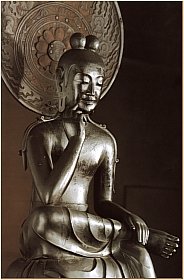 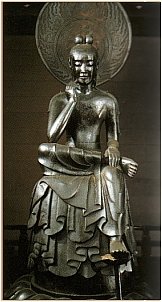
Miroku Bosatsu (Two views of same statue)
7th Century AD, Wood, Chuuguuji Temple 中宮寺 (Nara)
87 cm in height, Made of Japanese Cinnamon Wood
Chūgūji Temple is a nunnery. It was commissioned by Prince Shōtoku after the death in +621 of his mother, Empress Hashihito (Anahobe-no-Hashihito 穴穂部間人皇女), for the repose of her soul. Hashihito was the consort of Shōtoku’s father, Emperor Yōmei 用明 (reigned + 585-587). It is built atop the former home of Shōtoku’s mother. Chūgūji is one of three nunneries of the ancient Yamato realm. Many of its head priestesses were imperial princesses (i.e., many were daughters of Japan’s emperors). The temple was originally located at the center of Prince Shōtoku’s lkaruga Palace, Okamoto Palace and Ashigaki Palace -- hence, the temple’s name, which literally means “temple in middle of palaces.” The site has been extensively excavated, and scholars say the temple was moved to its present site during the Muromachi period (+1331-1573). Today Chūgūji still serves as a special temple for the Imperial Family. <above paragraph adapted from this site>
Hokkeiji Temple 法華寺 in Nara was the head temple of all nunneries built in Japan during the 8th century. Once an imperial palace (Himuro Gosho), it became the head provincial nunnery. Hokke-ji was established as a convent in + 747 by Empress Komyo, who was the wife of Emperor Shomu. She had inherited the place from Fubito Fujiwara, her father. It is known both for its elegant garden and its national treasure, a 9th century Buddhist art masterpiece of an 11-headed Kannon, which is only on view three times per year. <above paragraph quoted from this site>
Says author Ken Joseph Jr., in his book LOST IDENTITY: After Prince Shōtoku's death, Princess Tachibana no Ooirasume 橘大郎女 desired to pay tribute to him and had a weaver from the Hata clan named Hatano Kuma (秦久麻) to weave a hanging mural depicting him entering "Tenjukoku" (天寿国, a word made up of the characters for "heaven", "long life" and "country"). This mural originally hung in Houryuuji, and the small portion of it that still remains is now stored in a nearby temple named Chuuguuji (中宮寺). Concerning this term "Tenjukoku", it is apparently not originally a Buddhist term at all, and the nature of the picture itself is rather non-Buddhist. In fact, a researcher by the name of Tomiyama Masanori (冨山昌徳) claims that this term "Tenjukoku" is in reality a term referring to the Heaven that Jesus taught. <end quote>
Another interesting aside from author Ken Joseph Jr., whose argues that Shōtoku was greatly influenced by Hata 秦 immigrants from central Asia (as far west as Assyria) who traveled along the silk road, and finally made their way to Japan via Korea and China. These Hata immigrants brought belief in Keikyo 景教 (early Christianity from central Asia, including Nestorianism) with them to Japan. The author argues convincingly that Shōtoku legends are mixed heavily with Christian influences. Click here for full details.
Hōki-ji 法起寺, also spelled Hokki-ji. Part of Hōryūji.
Formerly known as Okamoto-dera 岡本寺 and Ikejiri-dera 池後寺.
TEL: 0745-75-2555 Temple Web Site
Hokiji Temple is located in the Okamoto 岡本 region of lkaruga 斑鳩, an ancient village in the foothills northeast of Hōryūji Temple in Nara. It was originally known as Okamoto Temple 岡本寺, for it sits atop the 6th-century ruins of Okamoto no Miya 岡本宮, one of Prince Shōtoku’s palaces, and one where the prince reportedly gave a series of famous lectures on the Lotus Sutra and other Buddhist scriptures. The palace was reconstructed as a Buddhist temple by Shōtoku’s eldest son, Prince Yamashiro Ōe no Ō 山背大兄王 (Yamashiro Ōji 山背王子 for short) based on a request left in his father’s will. Says the Hokkiji web site: “The circumstances of the palace’s reconstruction as a Buddhist temple are found in the Private Recollections on the Life of Prince Shotoku 聖徳太子伝私記 (Editor’s Note: date not given for said document, but probably many decades, even centuries, after the death of the prince) which quotes from a metal inscription found on the temple’s three-story pagoda. The inscription records that in +622, Prince Shōtoku left a will for his eldest son, Prince Yamasiro Ōe 山背大兄王, to convert the palace into a Buddhist temple, and that the young prince donated from his holdings 12 cho of land in Yamato province and 30 cho of land in Omi province for the new temple. According to period records, Hokiji prospered during the Nara era. In the Heian period, however, Hokiji came under the control of Horyuji and its stature began to diminish. After the Meiji Restoration of +1868, Hokiji belonged to the Shingon esoteric sect of Buddhism. In +1882, when Horyuji and Kofukuji in Nara became affiliated with the Hosso sect, Hokiji became a branch of the same sect. More recently, in 1950, Hokiji was again placed under the control of Horyuji when the latter established itself as the headquarters of the Shōtoku sect. The temple maintains a statue of the 11-Headed Kannon (Goddess of Mercy), designated an important cultural asset.” <end temple quote> For more details on the temple’s history, see the Temple Web Site.
Couriously, there is a deity in Japan known as Hōki Bosatsu 法起菩薩 (also spelled Hoki, Houki). The characters for Hōki 法起 are exactly the same as the characters of Hōkiji Temple 法起, which could be loosely translated as “arising Dharma” or “awakening knowledge.” A secret image of this deity is found at Bodaiji Temple 菩提寺の秘佛 in nearby Hyogo Prefecture. Says site contributor Gabi Greve: “This Bosatsu is not very familiar, but he is one of the protector deities of mountain ascetics, ranging back to the time of En no Gyoja, the latter the most famous mountain holy man of the 7th century. Hōki Bosatsu is sometimes depicted with six arms and five eyes 五眼六臂. He is also seen as an incarnation of Hōdō Sennin 法道仙人, an Indian ascetic who, according to well-known legends, lived in the 7th century during the time of Emperor Suiko and Shōtoku, and walked all the way through China and Korea until he reached Japan. He walked with his companion, the God of the Bulls, Gozu Tenō 牛頭天王. Hodo Sennin is very popular in the area around Himeji in Hyogo Prefecture, which is also an area with strong connections to Shōtoku legends. Hodo Sennin is said to have founded Bodai-Ji Temple 菩提寺 and a few others in this region.” <end quote>
The link between Hōkiji Temple and Hōki Bosatsu is unknown, but Hōki Bosatsu is clearly an esoteric deity, and Hōkiji Temple was affiliated with the Shingon sect of esoteric Buddhism for a time. Also, Shōtoku maintained many associations with the Shinto cults of his day, and it is an least plausible that Hōkiji Temple may be in some way associated with Japan’s early mountain cults. See Gabi Greve page for photo.
Hōrin-ji 法輪寺, 法琳寺. Also spelled Hourinjin, Horinji
Unofficial Temple Web Site | Temple Treasures (outside J-link)
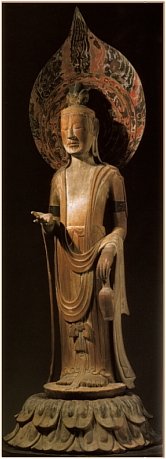
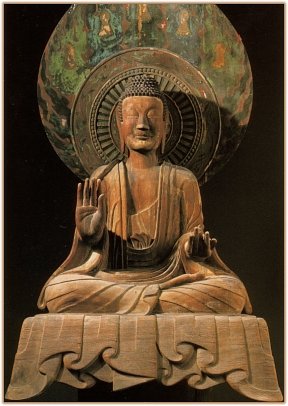
Also known as Mii-dera 三井寺 or 御井寺. Reportedly built by Shotoku’s son Prince Yamashiro Ōe no Ō 山背大兄王 in +621 as a prayer for the recovery his father’s health, although records are unclear and some disagree about the temple’s origins. The temple is located about one kilometer from nearby Hōryū-ji, and contains wonderful examples of wood Buddhist statuary from the Asuka period, including a seated Yakushi Nyorai (Buddha of Medicine) and a standing image of Kokūzō Bosatsu, both designated important cultural properties. Photos of both statues are presented below. The temple also maintains Heian-era statues of Kichijōten, Shō-Kannon and Bishamonten and the Eleven-Headed Kannon (the latter about 4.8 meters in height). Hōrin-ji Temple is a designated national treasure, but its famous three-story pagoda (the last structure still remaining of the original temple) was destroyed by lighting in 1944, and a reconstructed version was erected in 1975. ADDRESS: 〒636‐0101 奈良県生駒郡斑鳩町三井1570
TEL: 0745-75-2686 (Friends of Horinji Association).
|
|
|
|
Kokūzō Bosatsu, 7th Century
Wood, Height = 175.4 cm
Hōrin-ji 法輪寺, 法琳寺 in Nara.
Also spelled Hourinjin, Horinji.
|
Yakushi Nyorai, Late 7th Century AD
Wood, 110.6 cm in Height
Hōrin-ji 法輪寺, 法琳寺 in Nara.
Also spelled Hourinjin, Horinji.
|
|
Kōryūji (Kouryuuji) 広隆寺.
Open Daily from 9 am to 4.30 pm. Admission ¥600
Originally known as Hachioka Dera 蜂岡寺, Uzumasadera 太秦寺, and Hatano Kimidera 秦公寺. Many old temples are connected with Prince Shōtoku. According to the Nihon-shoki (日本書紀, Chronicles of Japan, circa +720, one of Japan’s oldest surviving documents), Kōryūji Temple was founded in + 622 by Hata-no-Kawakatsu for the repose of the soul of recently deceased Prince Shōtoku. It is one of Japan's oldest temples and although the main hall was reconstructed in + 1165, most of the Buddha statues it houses were carved in the 7th and 8th centuries. <Above paragraph adapted from this outside site>
Says Travelotica Travel Guide to Koryuji: Koryu-ji's main attractions are the Buddhist statues kept in the modern Reihoden (Treasure House) at the back of the compound. The "newest" of these images is a thirteenth-century statue of Prince Shōtoku aged 16 years, his sweet face framed by bun-shaped pigtails, while the oldest dominates the room with its sheer beauty. This is the exquisite Miroku Bosatsu, the Future Buddha rendered as a Bodhisattva pondering how to save mankind. It is believed to have been gilded originally and was probably a gift to Shōtoku from the Korean court in the early seventh century. Its soft, delicate features are certainly unlike contemporary Japanese images. The small, slim figure sits, elbow on knee, leaning forward slightly and head tilted in a pose of utter concentration. <end quote Travelotica>
Says author Ken Joseph Jr., in his book LOST IDENTITY: “The present Kōryūji Temple does not retain any of the original buildings. In fact, a Confucian scholar of the late Edo period, Ota Kinjo (1765 - 1825) commented about Kouryuuji: "This temple has the name of a temple, but it is not a Buddhist temple." Ota says the architecture of Kouryuuji must have been based on the Keikyo churches (大秦寺, Jp. = Daishinji) of Chouan (長安) in China. (Editor’s Note: Chinese capital of Chang'an 長安 (Jp. = Chōan). Today, Chang'an is known as Xian (Jp. = Seian 西安), and is home to one of the most significant archeological excavations of the 20th century -- a massive discovery of terra cotta statues and artifacts (outside link) dating back to China's Qin Dynasty (− 211-206). Likewise, Ota said that the unusual shape of the statue of Buddha in the temple was probably based on the icons in Keikyo churches. The characters used for "Uzumasadera" (太秦寺) are almost the same as the "Taishinji" (大秦寺) Keikyo churches of China, with the only difference being the extra "dot" in 太 (a character that means "great" as opposed to 大, which means "big"). Ancient records, however, indicate that the other name for Kouryuuji, "Uzumasadera", was also sometimes written as大秦寺. It's also important to note that the characters 大秦 were used in China to refer to the areas west of China, particularly the Syrian (Assyrian) region of the Roman Empire, from which Keikyo had come.”
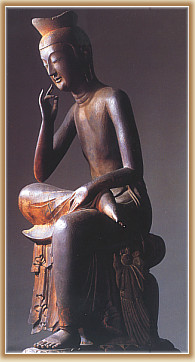
Miroku Bosatsu, 7th Century, Kyoto, National Treasure
Kouryuu-ji Temple, Wood, H = 84.2 cm
Photo Courtesy of book entitled Concise History of Japanese Buddhist Sculpture (page 015)
Bijutsu Shuppan-Sha, ISBN 4-568-40061-9 http://www.bijutsu.co.jp
Below Text from LOST IDENTITY by Ken Joseph Jr.
How "Messiah" Became "Miroku." Kouryuuji contains the famous Miroku 弥勒 Bodhisattva (Bosatsu 菩薩 in Japanese), which refers to a Buddhist saint who postpones nirvana in order to assist suffering mankind. "Miroku" comes from the Sanskrit "Maitreya", which means "The Benevolent One." The statue at Kouryuuji is considered a national treasure. I have been to see this art treasure for myself, and it certainly does have an expression of beauty and tranquility. The smile on the face is said to be an "eternal smile," and with this, I could certainly concur. The German philosopher Karl Jaspers wrote upon viewing the statue, "The Miroku at Kouryuuji is truly a full representation of the highest expression of human nature. ... In my several decade-long career as a philosopher, I have never seen any other work of art that so completely expresses a feeling of true peace." There just seems to be a mystical attraction to this statue that appeals to our longing for peace and tranquility. Since this statue is in Kouryuuji, a Buddhist temple, many simply assume that its roots are in Buddhism. A careful study of the statue, however, reveals something very interesting about the right hand. When I first looked at it carefully, I realized that there was something familiar about that pose. The right hand is raised up with the thumb and one finger touching together to form a triangle. The other three fingers are extended out more or less straight. Actually, this same pose is one that was commonly used in Keikyo churches, and examples have been found in the ruins of ancient Keikyo churches. For instance, in Tonko (敦煌) in western China, a wall painting of a Keikyo bishop was discovered by Count Aurel Stein in 1908. This picture of a Keikyo bishop was found together with other Keikyo artifacts in a cave that had been sealed in the year + 1036. A cross can clearly be seen in the restored picture in three locations, on the tip of the rod, on the forehead and on the chest. When the painting first came to light, more than half of it was no longer present, and from the pieces that remained, many just assumed that it was a painting of the Buddha. However, modern technology has enabled scholars to determine what was in the missing areas, and it was discovered that it contained 3 Keikyo crosses. Even without the enhancement of modern technology, however, the shape of the right hand was clearly visible. The bishop held the tip of one finger against his thumb to form a triangle and the other three fingers were extended in a style practically identical to that of the Miroku Bodhisattva. The followers of Keikyo were known for using a variety of symbols. They also believed in the orthodox doctrine of Christianity known as the "Trinity" (namely, that the one God exists in three entities, the Father, the Son and the Holy Spirit). Researchers into Keikyo history tell us that the finger and thumb forming a triangle with the other three fingers held out form a double symbol that represents this central tenet of their faith. In modern times, we often see people holding up two fingers in a "V" sign signaling either victory or peace. This way of holding their fingers is similar to that and was the way Keikyo believers signaled their faith to others.
Let's take a look now at what "Miroku" means within the Buddhist context. Miroku is considered to represent the coming savior and certainly resembles the Second Coming of Christ in Christian terms. In the Buddhist writings "Miroku Geshokyo", it says that when the "Miroku" comes to earth, robbers and other evil people will be no more and that floods, fires, wars, famine and disease will disappear. Needless to say, this is very similar to how the "Millennial Kingdom" that is ushered in by Christ at his Second Coming as described in the Bible. The Buddhist concept of Miroku (Maitreya) first appeared in India in the 4th century A.D.* This was well after the introduction of Christianity into India in the middle of the 1st century. Already by the 2nd century, the idea of a "Savior Buddha" had been imported from Christianity. Buddhism had begun to decline in popularity, and by the 4th century, Buddhism was in sharp decline. Thus, it was in desperation that Buddhists sought something to counter the promise of a Savior Christianity offered. During this same period, Persian religion in the form of Zoroastrianism also was exerting a strong influence in India, and it too had this concept of a coming savior. Thus, this combination of Persian and Christian influence became manifest in Buddhism as the "Maitreya" concept in India, which later became the Miroku of Japan. The well-known scholar of comparative religions, Elizabeth A. Gordon, based her conclusions on a wealth of evidence, saying, "The Maitreya of India became the Mirefu (?) of China and later the Miroku of Japan. These words are equivalent to the Messiah of Hebrew and the Christos of Greek." Professor Ikeda Sakae of Kyoto University stated that the Christ (Messiah) of the Keikyo believers of China and the Miroku of Japan were of common origin. In other words, the fact that the Miroku statue is from a temple founded by the Hata clan is of great importance. It would appear that the Hata people did not dismiss Buddhism outright, but instead saw the Messiah Jesus in the Miroku statue.
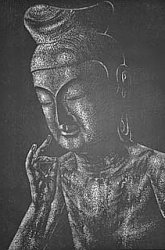 Kōryūji Temple Was Dedicated to "Uzumasa" Kōryūji Temple Was Dedicated to "Uzumasa"
There is a group of idols in Kouryuuji that are called the "Twelve Idols." These "gods" are in the form of humans, but they do not look like Chinese or Indians at all. In fact, their appearance looks very much like the ancient Romans. Thus, here too we see a vestige of the Silk Road. As mentioned above, Kouryuuji was established by Hatano Kawakatsu, the leader of the Hata clan, who was a person highly revered in Japanese society. He was recognized by Shoutoku Taishi (聖徳太子, Prince Shoutoku) and had achieved the second rank in the "Twelve Ranks of the Crown" system set up by Shoutoku Taishi.
Records indicate that Hatano was not ethnically the same as the typical Japanese of that day, and "His countenance was not that of a typical person." (Hayashi Razan, "Honcho Jinja Ko", 17th century). Hatano's name also appears in the "Nihon Shoki" (Chronicles of Japan). According to the Chronicles, in the 7th century, during the reign of Emperor Kogyoku (from 642 to 645 A.D.), people sang Hatano Kawakatsu's praise, saying, "Uzumasa has the reputation of a god among the gods, because he can put down the gods of this world." It would appear that in this context "Uzumasa" was the name of the god enshrined in the temple. The name "Uzumasa" still remains to this day as the name of the district in Kyoto where Kouryuuji is located, and it seems that the people of that day understood "Uzumasu" to be referring to Hatano Kawakatsu. To the Hata people themselves, however, it had a special meaning. In fact, according to Professor Saeki Yoshiro (as well as other scholars, such as Teshima Ikuro), "Uzumasa" was probably derived from the Aramaic or Syrian words for Jesus, the Messiah, which was "Ishu M'shekha" (Ishu Masha) It is easy to imagine this Aramaic rendering of the name known in English as Jesus Christ being transformed into the Japanese phonetic system and coming out "Uzumasa". I can just picture the Hata people calling out the name "Uzumasa" during their religious services. Upon hearing that, the local people, who didn't really understand the meaning, then associated that name with the people who used it. Likewise, the characters that were chosen to represent this name were 太秦, with the 秦 being the same character as "Hata". Practically these same characters are what are found in the Keikyo churches of ancient China (except with 大 instead of 太), again, pointing to their Christian origins. A similar thing occurred later during the "Kirishitan" times when the Latin phrase "Deus" (God) was heard as "Daiusu". As there were numerous "Kirishitan" Christians in a certain section of Kyoto, that section became known as "Daiusu Machi", a name that is still used today. Thus, Daiusu and Uzumasa both still remain as place names in Kyoto to this day. Within the grounds of Kouryuuji, there is an ancient well that goes by the name of "Isarai". This well is referred to in records from the temple dating to 873 A.D. as being an old well, and so it dates back long before that even. It appears that the Hata tribe used the well not only for drinking water, but also for holy water to be used in their religious ceremonies. My father took a picture of "Isarai" to the Ashurbanipal Museum in Chicago to a scholar of Aramaic named Homer Assurian. The answer he received to his inquiry was that "Isarai" probably comes from the Aramaic phrase meaning "Jesus is (my) shepherd." "Isa" is Jesus, and "rai" is "shepherd." Thus, it is likely that the name is a reference to the 23rd Psalm. My father and I have met Mr. Honma, the present owner of this well. He invited us into his home and showed us the geneology of the Hata people that had been handed down from his ancestors. When we told him about what we had discovered concerning the name, "Isarai", he was really excited about it. In passing, however, we should mention one other theory of the origin of this name. In Chinese records, the nation of Israel is referred to by the name 一賜楽業, which is given the reading in Chinese "Isurae." Thus, some have supposed that Isarai comes from the name for Israel. It's interesting to note that "Jacob's Well" played an important role in biblical history, and the new name that God gave Jacob was "Israel". Thus, that well could also be referred to as "Israel's Well". Therefore, both of these theories point to the biblical roots of this name. <end quote by Ken Joseph Jr.>
Ikaruga-dera 斑鳩寺
Near the famous Himeji Castle in Hyōgo Prefecture.
Tendai Sect. Closely connected with Prince Shōtoku.
Temple Web Page | Map to Temple
姫路近くの聖徳太子ゆかりの天台宗の寺院
Address: 兵庫県揖保郡、太子町鵤 709、〒671-1561
TEL.0792-76-0022 | FAX.0792-76-3433
Ikarugadera Temple 斑鳩寺 in Hyōgo Prefecture has close ties with Prince Shōtoku. The Hyōgo temple, however, should not be confused with Hōryūji Temple in Nara, which is also known as Ikaruga-dera. (Note: Ikaruga is the name of a small town in Nara City where Hōryūji Temple is located, hence the name Ikaruga-dera.) Says author Ken Joseph Jr., in his book LOST IDENTITY: At the temple (in Hyōgo), there is an interesting little globe that is very ancient. The fact that it represents the earth as a sphere is surprising enough, but it also has engraved on its surface the continents of Europe and Africa along with Asia, including India and China. Their shapes are not surprisingly rather distorted, but they are recognizable. Japan is likewise featured off the coast, but without the island of Hokkaido. The globe is carved out of stone, with the land masses raised in relief above the oceans. As to when the globe was carved, we have no clear evidence other than it was many centuries ago. In the Europe of the middle ages, the spherical nature of the earth was denied, and so it has only been in more recent times that spherical globes have been made. Nevertheless, in ancient Greece, the spherical nature of the earth was understood, with even a quite accurate estimate of the circumference of the earth being determined. The first globe that is recorded to have been made was in 150 BC by Kuratesu or Marosu. The Islamic cultures of the Middle East were influenced by Greek science and apparently they made globes as well from very early in their history. The earliest record of a globe existing in China was not until +1267, but it is likely that with the robust trade taking place along the Silk Road that such globes were brought from western Asia much earlier. Thus, even if the globe at Ikarugadera 斑鳩寺 is 1000 or more years old, it would not be surprising. Some have speculated that it was introduced during Prince Shōtoku's time from western Asia, while others have said that he himself made it. It is referred to at Ikarugadera as "Prince Shōtoku's Globe." Whatever the case, it is at least plausible that it had some relationship to Prince Shōtoku, especially since it belongs to an ancient temple closely associated with Shōtoku. We know from a variety of lines of evidence that Prince Shōtoku was far more international than was true during later periods in Japanese history, with various recent immigrants from the Asian mainland, including many Keikyo believers. From what we know about ancient Buddhism, it is unlikely that the kind of knowledge represented in the globe would have come from Buddhism, and so it is more likely that it had Christian or Islamic roots.
HANKYU-JI (Editor’s Note: Unconfirmed Research)
According to the Nihon-shoki, Prince Shōtoku gave lessons on the Shoman-gyo Sutra and Hokke-kyo Sutra (Lotus Sutra) to Emperor Suiko 推古 (reigned + 592 to 628) at this temple. The Empress, his aunt from the Soga clan, was very pleased, and gave Shōtoku a rice paddy in Harima (Hyōgo Prefecture). Prince Shōtoku named this place Ikaruga-so and founded a temple here. <quote unconfirmed; found here>
Asuka Period 飛鳥時代 (538 to 710 AD)
Artistic Influence from Mainland Asia
See Asuka Art Photo Tour Page (50+ Pix)
Buddhist iconography and artwork first came to Japan via mainland Asia in the Asuka Period (538 - 651 AD), with the earliest sculptures mostly imported from Korea then China. The early Asuka Era is also referred to as the Suiko Period 推古時代, in reference to Empress Suiko 推古 who reigned from 592 to 628 AD. Her nephew was Prince Shoutoku, who is widely credited as the main force behind the introduction of Buddhism to Japan. The late Asuka Era 飛鳥時代後期 is also referred to as the Hakuhou Era (645-710 AD). These times were marked by court patronage of Buddhism, a rapid expansion in Buddhist beliefs, the construction of temples throughout Japan, and the creation of numerous works of Buddhist art. The most important surviving temples from the period are Hōryūji Temple 法隆寺 (Nara), Yakushiji Temple 薬師寺 (Nara), and Shitennōji Temple 四天王寺 (Osaka), all modern-day treasure houses of Japan’s early Buddhist artwork.
During the Asuka Period, the capital was located in and around the Asuka District, part of modern-day Nara Prefecture, and Buddhist culture flourished thanks to the patronage of Empress Suiko and her nephew, Prince Shoutoku. During this period, the Sanron School of Buddhism was in favor. It was a period when professional carvers from Korea and China traveled to Japan to teach the arts of carving and sculpture. These and other emissaries brought the Chinese written and spoken language, which remained the de facto language of the young Japanese nation until the 9th century.
Other Related Web Resources and Shōtoku Lore
Shōtoku’s Association with Daruma, Father of Zen Buddhism
- Says Bernard Faure, Professor, Religious Studies, Stanford University
“For somewhat obscure reasons, Daruma is said to be a protector of horses and monkeys (see Monkey, Protector of Stables). A rather unusual motif is that of his relation with the "Prince of the Stable" (umayado 厩戸), that is, Imperial Prince Shōtoku Taishi (+ 574 - 622), whose legend has him born in a stable. On that occasion, Bodhidharma (Daruma) is said to have reincarnated himself as a horse, which neighed three times. This may still have to do with the notion of Daruma as a ‘placenta deity.’" <end abridged quote from Bernard Faure, from THE PATRIARCH WHO CAME FROM THE WEST. Daruma, Smallpox and the Color Red, the Double Life of a Patriarch. See full story at Gabi Greve's Daruma Web>
- Writes Dr. Gabi Greve: “Essentially, the story goes like this. According to Chinese legend, a few years after the death of Daruma, a Chinese official encountered him in the mountains of Central Asia. Bodhidharma (aka Daruma) was carrying a staff with a single sandal dangling from it. He reportedly told the official he was on his way back to India. When this story made its way back to China, monks decided to open Bodhidharma’s tomb. Inside they found only a single sandal. The story somehow continues onward into Japan. One day, Shōtoku was walking near the Japanese village of Kataoka 片岡 (incidentally, very near Hōryūji Temple). During his walk, he met a poor man and gave him a purple cloth. The man died the next day. When Shōtoku made inquires about the man's whereabouts, his assistants reported that the old man had died, whereupon they were ordered to open his grave. Inside they found no body -- just a purple cloth folded nicely. Prince Shōtoku apparently exclaimed: ’This must have been Daruma, the Founder of Zen.’ The people of that time thought ’How true it is that a sage knoweth a sage. It takes a holy man to recognize another holy man.’"
|
|