|
|
|
|

|
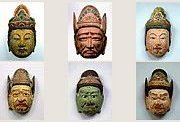
Visit Kyoto National Museum for
more on the 12. Click any image.
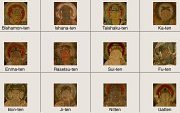
|
|
じゅうにてん
Jūniten 十二天 or 十二大天衆
Twelve Deities, 12 Deva, 12 Celestial Beings
Also spelled Juniten, Juuniten. Literally Twelve 十二 Deities 天
Protectors of Buddhism
Doctrine-Abiding Deities Guarding All Directions
Minor Gods in Pantheon of Esoteric Buddhism
Origin : India, Hindu Deities
Members of the larger TENBU GROUP of
Hindu gods incorporated into Buddhism
|
Deities of the 12 directions in Japanese Esoteric Buddhism (Mikkyō 密教), including the four directions and four semi-directions, up and down, and sun and moon. Deva is a Sanskrit term meaning god, deity, or celestial being. It is rendered as Ten 天 in Japan (天 literally means Heaven or Celestial). The Deva are deities borrowed from Hindu mythology and adopted into Chinese and Japanese Buddhism as guardians of the monasteries of Esoteric Buddhism. They appear frequently in Japanese mandala. Among the 12, Bonten (Brahma) and Taishakuten (Indra) serve in the highest position. Also known as the Twelve Gods Protecting the World. For a larger listing of nearly 80 Deva, click here.
|
|
- Bonten 梵天 (Skt. = Brahmā); Up; Heaven Deva
- Taishakuten 帝釈天 (Skt. Indra); East; Lord of Deva
- Suiten 水天 (Skt. Varuna); West; Water Deva
- Bishamonten 毘沙門天 (Vaiśravana); North; Wealth
- Enmaten 焔魔天 (Skt. Yama); South; Underworld
- Katen 火天 (Skt. Agni); Southeast, Fire Deva
- Rasetsuten 羅刹天 (Skt. Raksasa); SW; Demons
- Ishanaten 伊舎那天 (Skt. Isana); NE, Dharma
- Futen 風天 (Skt. Vayu); NW; Wind Deva
- Nitten 日天 (Skt. Aditya); Sun Deva
- Gatten 月天 (Skt. Candra); Moon Deva
- Jiten 地天 (Skt. Prthivi); Down; Earth Deva.
|
|
|
|
|
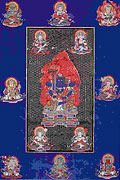
Jūniten Mandala 十二天曼荼羅
Courtesy Mt. Kōya, Japan
Mandala of Twelve Celestials.
Kongōbuji Temple 金剛峯寺
Mt. Kōya 高野, Wakayama Pref.
|
|
The Twelve in Japanese Artwork. The Jūniten (12 Deva Guardians) originated from the Hindu guardians of the four cardinal and four intermediary directions (Jp. = Happōten 八方天). In later years, the gods of heaven and earth were added to create a grouping called the Ten Deities (Jp. = Jitten 十天), and still later the gods of the sun and moon were added to create the Jūniten (Group of 12 Deva). These twelve generally supplant the Shitennō (Four Heavenly Deva Kings) in esoteric artwork in Japan, although they serve the same role as the Shitennō in protecting Buddhism and crushing evil demons. As a group, the 12 appear from the Heian-era (794-1185) onward in paintings of the Taizōkai Mandala or as a set of processional masks. From the 12th century onward, they were depicted in pairs on six-paneled folding screens called Jūniten Byōbu 十二天屏風. The Kyoto National Museum possesses paintings and masks from the late Heian period. However, to my knowledge, statues of all 12 (as a group) do not exist. The 12 also appear in the Jūniten Mandala and the Anchin Mandala. Four of them also serve as guardians of the four directions and appear on the four directional sides of old steles. See Five-Element Pagoda for details. <Source: JAANUS> |
|
RETURN TO TOP OF PAGE
|
|
Japanese Name
|
Description
|
|
Bonten
梵天
Dai Bontenno
(Great Heavenly
King Brahma)
Photo:
Nara Era (710-794)
Hōryū-ji Temple 法隆寺
(Nara)
Photo courtesy of
”Handbook on Viewing Buddhist Statues” by Ishii Ayako. Click here to buy book at Amazon
|
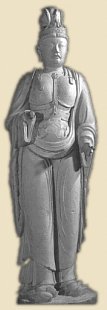 Heaven Deva; Skt. = Brahmā or Sikhin; guards the upward direction; Hindi deity who created the universe, with four heads for overlooking each of the four directions (although often shown with only one). Also known as the universal soul, in contrast to the individual soul (atman). Bonten’s “vahana” is the wild goose. Four infinite virtues are attached to Bonten: (1) give others happiness; (2) remove their suffering; (3) help them see, thus freeing them from desire; (4) help them abandon attachment to love and hate to become impartial to all. One can attain rebirth in the Brahma Heaven, it is said, by practising these virtues. Bonten lives in the first of four meditation heavens, in the world of form, above Mount Sumeru; said to rule the “saha” (Sanskrit word for endurance and for the world of suffering); people in the saha world endure many sufferings caused by desire and three poisons -- greed, anger and foolishness. For another photo of Bonten, click here. Heaven Deva; Skt. = Brahmā or Sikhin; guards the upward direction; Hindi deity who created the universe, with four heads for overlooking each of the four directions (although often shown with only one). Also known as the universal soul, in contrast to the individual soul (atman). Bonten’s “vahana” is the wild goose. Four infinite virtues are attached to Bonten: (1) give others happiness; (2) remove their suffering; (3) help them see, thus freeing them from desire; (4) help them abandon attachment to love and hate to become impartial to all. One can attain rebirth in the Brahma Heaven, it is said, by practising these virtues. Bonten lives in the first of four meditation heavens, in the world of form, above Mount Sumeru; said to rule the “saha” (Sanskrit word for endurance and for the world of suffering); people in the saha world endure many sufferings caused by desire and three poisons -- greed, anger and foolishness. For another photo of Bonten, click here.
|
|
RETURN TO TOP OF PAGE
|
|
Taishakuten
帝釈天
Photo:
Nara Era (710-794)
Hōryū-ji Temple 法隆寺
(Nara)
Photo courtesy of
”Handbook on Viewing Buddhist Statues” by Ishii Ayako. Click here to buy book at Amazon
|
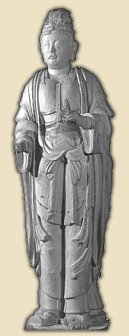 East. Skt = Indra, Indira, or Sakradevanam. Indra is the Hindu god of war; Taishakuten is also represented at the center of the world when grouped with the Shitennō. East. Skt = Indra, Indira, or Sakradevanam. Indra is the Hindu god of war; Taishakuten is also represented at the center of the world when grouped with the Shitennō.
He governs the 32 other gods who live in Zenkenjo (Palace of Correct Views) in the Buddhist heaven (Trayastrimsha) on the peak of Mt. Sumeru
Worshipped in Japan, China and Tibet.
Click here for more about Taishakuten.
|
|
RETURN TO TOP OF PAGE
|
|
Bishamonten
毘沙門天
Also
known as
Tamonten 多聞天
Photo:
Heian Era (794-1185)
Kurama-dera 鞍馬寺
(Kyoto)
Photo courtesy of
”Handbook on Viewing Buddhist Statues” by Ishii Ayako. Click here to buy book at Amazon
|
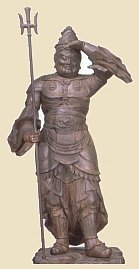 North; Skt : Vaisravana, Vaishravana. Means “Listens to the Teachings of Buddha;” protects all locations where the Buddha preaches; lives halfway down northern side of Mount Sumeru; accompanied by the Yaksha and Raksha; also known as the god of wealth and warriors; usually clad in armor, with a spear in one hand and a pagoda in the other; the scourge of evil doers; one of the Four Guardians of Buddhism (Shitennō); one of Japan’s Seven Lucky Gods; pagoda he carries symbolizes the divine treasure house; he is both a protector of and dispenser of treasure (shares the pagoda’s vast treasures with only "the worthy"). Bishamonten is also worshipped independently, and at one time enjoyed a strong cult following in Japan. See the Bishamonten page for more on this deity. Also see our Tamonten page. North; Skt : Vaisravana, Vaishravana. Means “Listens to the Teachings of Buddha;” protects all locations where the Buddha preaches; lives halfway down northern side of Mount Sumeru; accompanied by the Yaksha and Raksha; also known as the god of wealth and warriors; usually clad in armor, with a spear in one hand and a pagoda in the other; the scourge of evil doers; one of the Four Guardians of Buddhism (Shitennō); one of Japan’s Seven Lucky Gods; pagoda he carries symbolizes the divine treasure house; he is both a protector of and dispenser of treasure (shares the pagoda’s vast treasures with only "the worthy"). Bishamonten is also worshipped independently, and at one time enjoyed a strong cult following in Japan. See the Bishamonten page for more on this deity. Also see our Tamonten page.
|
|
RETURN TO TOP OF PAGE
|
|
Katen
火天
Photo:
Heain Era Mask
10th century
Kyoto National Museum
|
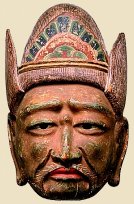 Southeast; Fire Deva; Skt : Agni. God of fire, invoked in Shingon fire rituals (Agni homa ritual); carries messages to the gods in the flames and smoke of fire; often depicted as old man with stern facial expression. Southeast; Fire Deva; Skt : Agni. God of fire, invoked in Shingon fire rituals (Agni homa ritual); carries messages to the gods in the flames and smoke of fire; often depicted as old man with stern facial expression.
|
|
RETURN TO TOP OF PAGE
|
|
Enmaten
Emmaten
Emma
焔魔天 or 炎魔天
Photo:
Kamakura Era (1185-1332)
Hōshaku-ji Temple 宝積寺
(Kyoto)
|
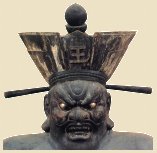 South; Hell Deva; Skt : Yama or Yama-raja. King of the Underworld; chief judge in the afterlife; when a person dies, s/he must appear before Enma (and also before other judges), who decides whether the person is good or bad; the person is then sent to the most appropriate afterworld; among the judges of hell, Enma is the most important. For details and artwork of Enma, please see this Kyoto National Museum page. Or see Ten Kings / Judges of Hell for more details. South; Hell Deva; Skt : Yama or Yama-raja. King of the Underworld; chief judge in the afterlife; when a person dies, s/he must appear before Enma (and also before other judges), who decides whether the person is good or bad; the person is then sent to the most appropriate afterworld; among the judges of hell, Enma is the most important. For details and artwork of Enma, please see this Kyoto National Museum page. Or see Ten Kings / Judges of Hell for more details.
|
|
RETURN TO TOP OF PAGE
|
|
Rasetsuten
Rasatsu
Rasetsu
Raksa
Raksasa
Rakshasa
Rakushasa
羅刹天
Photo: Kamakura Era
Masuda Family
Hell Scroll
Located at
Nara National Museum
|
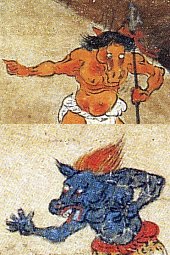 Southwest (Note: direction unconfirmed). Skt = Raksa (male); Raksais, Rākṣasīs (female). Among Hindu demons, the Raksa torture and feed upon the flesh of the dead (those who were evil while living); like the Ashura, these creatures become guardian deities once introduced to Buddhism; right hand often holds a sword. The Rākṣasīs (female) are the demon daughters of Kariteimo (one of Japan's most widely known Yaksha, who was originally a child-devouring deity from Hindu lore named Hāritī, but she repents and coverts to Buddhism). Her ten rākṣasīs apparently have black powerful bodies and eat humans. They are also known as the Ten Cannibal Demon Daughters (Jūrasetsu-nyo 十羅刹女), especially important to Japan’s Nichiren sect. These 10 demon daughters utter dharanis (magical chants, spells, and incantations) and became guardian deities once introduced to Buddhism; they are listed in the Lotus Sutra. For more details on the Rasetsu, please see JAANUS. Southwest (Note: direction unconfirmed). Skt = Raksa (male); Raksais, Rākṣasīs (female). Among Hindu demons, the Raksa torture and feed upon the flesh of the dead (those who were evil while living); like the Ashura, these creatures become guardian deities once introduced to Buddhism; right hand often holds a sword. The Rākṣasīs (female) are the demon daughters of Kariteimo (one of Japan's most widely known Yaksha, who was originally a child-devouring deity from Hindu lore named Hāritī, but she repents and coverts to Buddhism). Her ten rākṣasīs apparently have black powerful bodies and eat humans. They are also known as the Ten Cannibal Demon Daughters (Jūrasetsu-nyo 十羅刹女), especially important to Japan’s Nichiren sect. These 10 demon daughters utter dharanis (magical chants, spells, and incantations) and became guardian deities once introduced to Buddhism; they are listed in the Lotus Sutra. For more details on the Rasetsu, please see JAANUS.
Also, Bishamonten, the god who protects all places where the Buddha preaches, is guardian of the north, and he is accompanied by two classes of demons called Yaksha and Rasetsu (this page). The Beasts of Buddhist Hell are also known in Japan as "Gozu-Mezu" -- short for Gozu Rasetsu 牛頭羅刹 and Mezu Rasetsu 馬頭羅刹. With heads resembling those of ox / cows (Gozu 牛頭) and horses (Mezu 馬頭), they are said to torture and feed upon the flesh of the deceased (those who have committed sins and are thus in hell). The Rasetsu might be particularly monstrous Yaksha, or alternatively, the Yaksha might be Rasetsu who have pledged to serve the Deva as guardians of forests, villages, and towns. The iconography is unclear.
Says the Digital Dictionary of Buddhism: “Rasetsu 羅刹 or Rasetsuki 羅刹鬼. Sanskrit = Rākṣasa. An ogre, a kind of demon-spirit that resides in the heavenly realms, which has the power to influence and seduce humans, and then eat them. Derived from rakṣas, harm, injuring. Malignant spirits, demons; sometimes considered inferior to yakṣas, sometimes similar. Their place of abode was in Sri Lanka, where they are described as the original inhabitants, anthropophagi, at one time the terror of shipwrecked mariners. Also described as the barbarian races of ancient India. As demons they are described as terrifying, with black bodies, red hair, green eyes, devourers of men. In the Mahāyāna texts, these demons are converted to Buddhism and serve as protectors of the dharma. Female rākṣasas are called rākṣasīs 羅刹女. In the Lotus Sūtra, there are ten kinds of rākṣasī 十羅刹女 who protect the dharma. Also written 羅叉娑 (Skt. surākṣasa, grāha).” <end quote>
Says the Digital Dictionary of Buddhism: “Rasetsu ten 羅刹天. Sanskrit = Rākṣasa-deva. The deva controlling the rākṣasa 羅刹, who has his abode in the southwest corner of the heavens.” <end quote> .
|
|
RETURN TO TOP OF PAGE
|
|
Suiten
水天、水神、水王
Photo
Heian era 1127AD painting, Kyoto National Museum
|
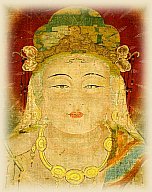 West; Water Deva; Skt : Varuna. Among the oldest Vedic gods, Suiten is the personification of the heavens, and preserver of the universe; later becomes the lord of the Sun Gods, and still later the god of oceans and rivers. Please visit the Kyoto National Museum for details and photo of this deity, or click here for other Japanese manifestations of Suiten. See our page on SUITEN for more details. . West; Water Deva; Skt : Varuna. Among the oldest Vedic gods, Suiten is the personification of the heavens, and preserver of the universe; later becomes the lord of the Sun Gods, and still later the god of oceans and rivers. Please visit the Kyoto National Museum for details and photo of this deity, or click here for other Japanese manifestations of Suiten. See our page on SUITEN for more details. .
|
|
RETURN TO TOP OF PAGE
|
|
Fūten, Futen, Fuuten
Fūjin, Fujin, Fuujin
風天
Photo:
Heain Era Mask
10th century
Kyoto National Museum
|
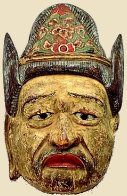 Northwest; Wind Deva. Sanskrit = Vayu, Anila, Gandhavaha. Typically appears as a elderly person, with white hair, red body armor, and holding a scepter of the wind in the right hand. The term “Futen-goshin-gassho” refers to a hand sign (mudra) in esoteric Buddhist practices, acheived by creating a "ring" with the index finger and the thumb. Fūten is also one of the Guardians of the Eight Directions (Happōten 八方天) and is also identified with Fūjin 風神 (God of Wind) -- the latter is one of the 28 Legions protecting the 1000-Armed Kannon. Northwest; Wind Deva. Sanskrit = Vayu, Anila, Gandhavaha. Typically appears as a elderly person, with white hair, red body armor, and holding a scepter of the wind in the right hand. The term “Futen-goshin-gassho” refers to a hand sign (mudra) in esoteric Buddhist practices, acheived by creating a "ring" with the index finger and the thumb. Fūten is also one of the Guardians of the Eight Directions (Happōten 八方天) and is also identified with Fūjin 風神 (God of Wind) -- the latter is one of the 28 Legions protecting the 1000-Armed Kannon.
Says Soothill: Vāyu. One of the twelve celestials 十二天. Originally the Indian god of wind, a deity who brings good fortune, posterity, and longevity. In Buddhism Vāyu becomes one of the guardian deities, included in the Garbhadhātu maṇḍala in the form of an old man. Transliterated as 嚩庾, 縛臾, 婆庾, 婆牖, and 伐由. Also translated as 風神 and 風大神. (Skt. Vāyu-daivata, Vāta; Pali Vāyu) 〔大日經 T 848.18.23b12〕
|
|
RETURN TO TOP OF PAGE
|
|
Ishanaten
Ishana
Daijizaiten
伊舎那天
Also known as
Jizai Ten 自在天
Sanskrit
Isana, Maheśvara, Śiva
|
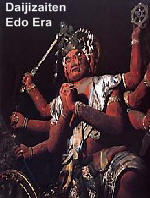 Northeast; Skt : Isana; said to live in the sixth, or highest, heaven of the world of desire; in right hand, often holds a three-pronged spear (trident), and in his left a bowl of blood (see painting at Kyoto National Museum); Ishana is an obscure dikpala (a god who guards one of the eight directions), whose name simply means "the Lord." Also one of the eight manifestations of Shiva. Northeast; Skt : Isana; said to live in the sixth, or highest, heaven of the world of desire; in right hand, often holds a three-pronged spear (trident), and in his left a bowl of blood (see painting at Kyoto National Museum); Ishana is an obscure dikpala (a god who guards one of the eight directions), whose name simply means "the Lord." Also one of the eight manifestations of Shiva.
Also known, in Japan, as Daijizaiten 大自在天, which is the translation of Sanskrit Mahesvara (also transliterated as Makeishura 摩醯首羅), one of the many names of Shiva (Siva), who, along with Brahma (Bonten 梵天) and Visnu is one of the three chief gods of Hinduism. Daijizaiten was adopted into Buddhism as a protector of the Buddhist teachings and became one of the "Twelve Deva" (this page). In this context he appears under the name Ishana 伊舎那. According to the traditions of Esoteric Buddhism, before becoming a Buddhist tutelary deity, Daijizaiten was first vanquished by Gouzanze Myou-ou 降三世明王, the conqueror of earthly desires. As a result he and his consort Uma 烏摩 (Skt: Uma) often appear in representations of Gouzanze, who is shown trampling them underfoot. Gigeiten 技芸天, a minor deity in Japan and patroness of the arts, is believed to have been born from Daijizaiten’s hairline. <above Daijizaiten text adapted from JAANUS>..
|
|
RETURN TO TOP OF PAGE
|
|
Jiten
Chiten
Kenrochijin
地天
Photo
12th century, Wood
Yōgōji Temple
(Kyoto)
|
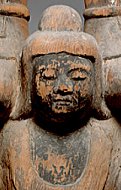 Earth Deva; Skt : Prthivi. Earth Deva; Skt : Prthivi.
Guards the downward direction; god of the earth. Jiten's counterpart is Bonten (Brahman), who guards the upward direction.
Says Soothill: The earth devā, one of the four with thunderbolts in the Vajradhātu group; also 地后 the earth devā in the Garbhadhātu group and 地神. (Skt. Dig-devatā, Pṛthivī-devatā) 〔瑜伽論 T 1579.30.302c7〕
|
|
RETURN TO TOP OF PAGE
|
|
Nitten
Dai Nittenno
Nikko
日天
Photo: Nara Era.
Treasure of
Tōdai-ji Temple 東大寺
(Nara)
|
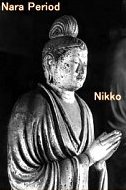 Sun Deva; Skt : Surya, Aditya Sun Deva; Skt : Surya, Aditya
Great Heavenly Sun King, a Hindu god adopted into Buddhism as a protector; said to be a subject of Taishakuten.
See the Nikko and Gakko page for more details. Also see Yakushi Nyorai, who is often flanked by Nikko and Gakko.
Nikko = Suryaprabha
Gakko=Candraprabha
|
|
RETURN TO TOP OF PAGE
|
|
Gatten
Gakko
月天
Photo:
Modern bust of Gakko
Courtesy this site
|
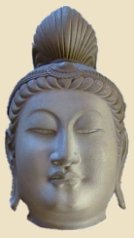 Moon Deva; Skt : Candra Moon Deva; Skt : Candra
Appears as a Bodhisattva; often depicted riding a white goose; Gatten sometimes holds a half moon with a rabbit in it
See the Nikko and Gakko page for more details. Also see Yakushi Nyorai, who is often flanked by Nikko and Gakko.
Nikko = Suryaprabha
Gakko=Candraprabha
|

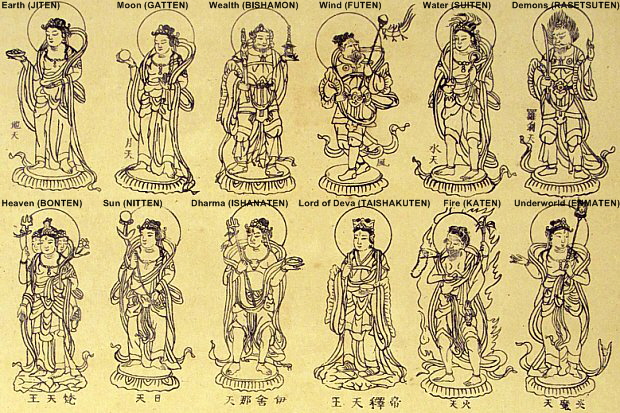
12 Deva from the Butsuzō-zu-i 仏像図彙
As reproduced by Philipp Franz von Siebold.
Nippon Archiv zur Beschreibung von Japan. Leiden (1831 CE)
Photo Page | Index Page | Top Page
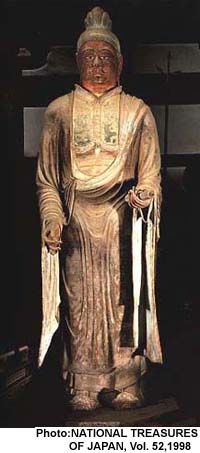 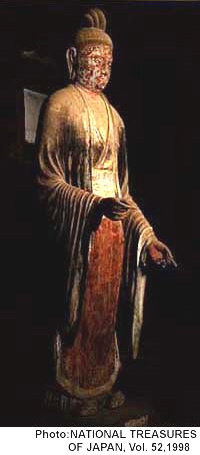
(L) Bonten and (R) Taishakuten, Mid 8th Century
Both located at at Sangatsu-do Hall, Toudai-ji Temple, Nara
Photos from homepage3.nifty.com/asunara/ten.htm
|
NOTEBOOK. The Deva (Jp. = Ten) represent the highest state of existence prior to the Theravada Arhat, the Mahayana Bosatsu, and at the very peak, are the Nyorai (Buddha). The Deva live for countless ages, but even they grow old and die, for they are still trapped in the Six States of Existence, the cycle of suffering, of rebirth and redeath (Sanskrit = samsara). There are six samsara states. The lowest three states are called the three evil paths (three bad states):
|
Lowest three states (three evil / bad) paths:
|
Highest three states:
|
|
All beings in these six states are doomed to death and rebirth (reincarnation) in a recurring cycle over countless ages -- unless they can break free from desire and the cycle of suffering. NOTE: The road from Hell to Buddhahood actually covers Ten States (the Ten Worlds), not just the six samsara states. Thus, there are four more states of existence above the TENBU (Deva).
|
|
|
|
SOURCES
- JAANUS. Japanese Architecture & Art Net Users System. Compiled by the late Dr. Mary Neighbour Parent; covers both Buddhist & Shinto deities in great detail. Over 8,000 entries.
- A Dictionary of Chinese Buddhist Terms. With Sanskrit & English Equivalents. Plus Sanskrit-Pali Index. By William Edward Soothill & Lewis Hodous. Hardcover, 530 pages. Published by Munshirm Manoharlal. Reprinted March 31, 2005. ISBN 8121511453.
- Butsuzō-zu-i 仏像図彙, the “Collected Illustrations of Buddhist Images.” Published in 1783 (Genroku 元禄 3). One of Japan’s first major studies of Buddhist iconography. Hundreds of pages and drawings, with deities classified into approximately 80 (eighty) categories. Modern-day reprints of the expanded Meiji-era version are available at this online store (J-site).
- Mandara Zuten 曼荼羅図典 (Japanese). The Mandala Dictionary. 422 pages. Published in 1993 by Daihorinkaku 大法輪閣. Language Japanese. ISBN-10: 480461102-9. Available at Amazon.
- Digital Dictionary of Chinese Buddhism (C. Muller; login "guest")
- Buddhism: Flammarion Iconographic Guides, by Louis Frederic, Printed in France, ISBN 2-08013-558-9, First published 1995. A highly illustrated volume, with special significance to those studying Japanese Buddhist iconography. Includes many of the myths and legends of mainland Asia as well, but its special strength is in its coverage of the Japanese tradition. Hundreds of accompanying images/photos, both B&W and color. A useful addition to your research bookshelf.
- Hindu Gods and Goddesses in Japan. Saroj Kumar Chaudhuri, Vedams, 2003, xviii, 184 p, ills, ISBN : 81-7936-009-1. See partial preview of book at Google Online Book Preview.
- Glossary of Hindi Gods (Art-and-Archeology.com). Also see their Buddhist Sculpture of Japan.
- See Bibliography for our complete list of resources on Japanese Buddhism, or visit any site page and scroll to the bottom for detailed resources on that specific deity or topic.
PHOTO RESOURCES
BUY ONLINE
- Buddhist-Artwork.com. Statues of Bishamonten, one of the 12 Deva,
are available for online purchase at our sister site.
|
|





