|
|
|
|
|
Last Update Jan. 14, 2015 (Ha & Heng)
VIDEO, Site author explaining Niō iconography (Oct. 2013)
NIŌ GUARDIANS (BENEVOLENT KINGS)
PROTECT ENTRANCE GATE AT TEMPLES
Emanations of Vajrapani Bodhisattva.
Represent Alpha & Omega, Beginning & End, Birth & Death.
One with mouth open, the other with mouth closed.
In Japan, also called Shitsukongō-shin, or Shukongō-shin.
Members of the Tenbu and Nijūhachi Bushū
Click Here for Special Niō Photo Tour
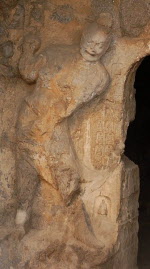
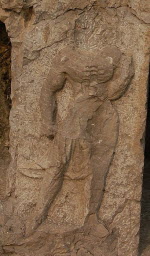
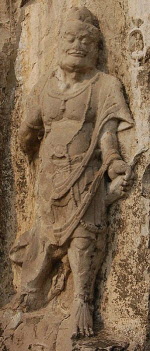
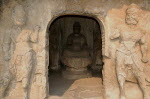
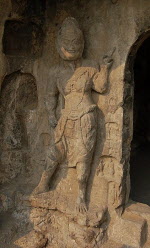
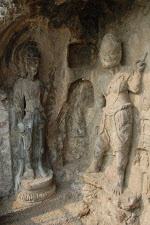
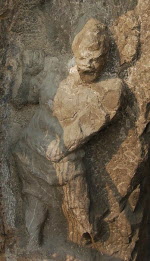
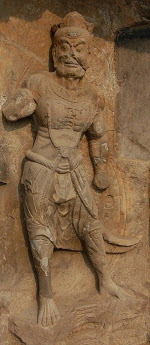
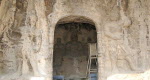
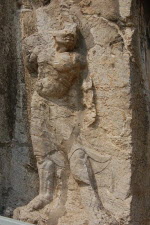
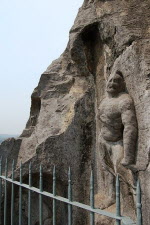
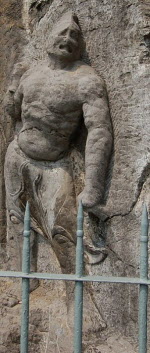
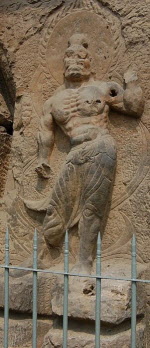
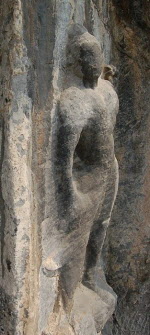
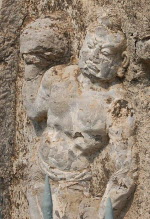
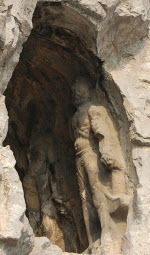
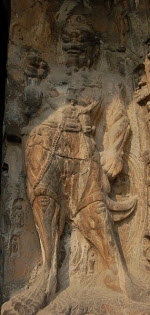
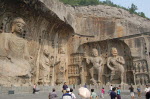
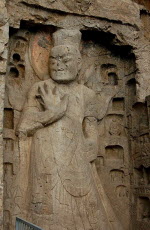
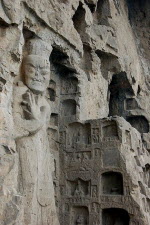
Longmen Caves (China), 5th to 10th Century
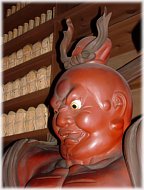 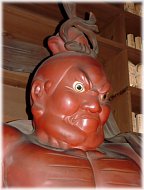
L = Agyō 阿形 (mouth open) R = Ungyō 吽形 (mouth closed)
At Hase Dera, Kamakura; Modern
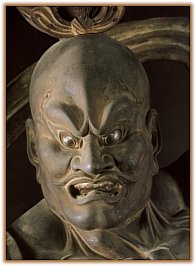 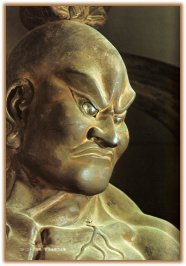
L = Agyō 阿形 (mouth open) R = Ungyō 吽形 (mouth closed)
At Sanjūsangendō 三十三間堂, Kyoto
12th Century, Life Size Wooden Statues
Scanned from Sanjūsangendō Brochure
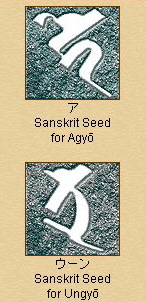
Agyō 阿形, AH-gyo, Agyo, Agyou, Naraen Kongō 那羅延金剛
Manifestation of Vairocana (Dainichi Nyorai).
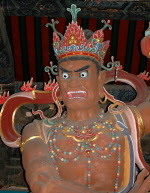
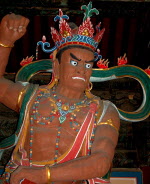
Shown with mouth open. Known as General “HA” in China.
Ungyō 吽形, Ungyo, Ungyou, Misshaku Kongō 密遮金剛
Manifestation of the Hindu God Vishnu.
Shown with mouth closed. Known as General “HENG” in China.
INTRODUCTION. Hindu Gods incorporated into Buddhism as protectors against evil spirits. If you look at their mouths, you will notice that one has its mouth open and the other has its mouth closed, said to represent life and death, the beginning and the end. The most famous Niō in Japan can be found at the entrance gate of Tōdaiji Temple 東大寺 in Nara. These 26-feet-tall statues were made in 1203 AD, reportedly under the direction of the famous sculptors Unkei and Kaikei. The Niō were introduced to Japan in the 7th or 8th century. The oldest extant statues of the two in Japan (dated to 711) are located at Hōryūji Temple 法隆寺 in Nara, and the 8th-century dry-lacquer sculptures at Tōdaiji Temple 東大寺 in Nara.
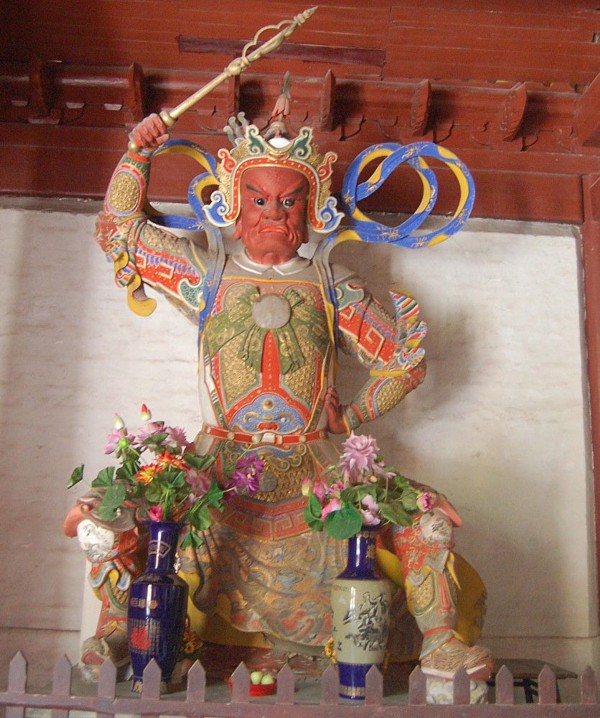
The Niō (Jp. = Benevolent Kings) are a pair of protectors who commonly stand guard outside the temple gate at Japanese Buddhist temples, one on either side of the entrance. The open-mouth version is commonly placed to the right of the temple, the closed-mouth version to the left. In Japan, the gate itself is often called the Niō-mon 仁王門 (literally Niō Gate). At Shintō shrines, however, the Niō guardians are replaced with a pair of koma-inu (shishi lion-dogs) or with two foxes. These mythical and magical shrine guardians are commonly (but not always) depicted with similar iconography -- one mouth open, one closed.
|
|

Origin = INDIA |
|
|
Japanese
|
|
|
Niō, Nio 仁王
(or Ninnō, Ninō 二王)
-- Agyō 阿形 --
Kongō Rikishi 金剛力士
Naraen Kongō 那羅延金剛
Mouth open uttering "AH"
-- Ungyō 吽形 --
Misshaku Rikishi 密遮力士
Misshaku Kongō 密遮金剛
Mouth shut uttering "UN"
|
|
|
Chinese
|
|
|
Èrwáng 二王
Erh-wang, Mouth open
Rénwáng 仁王, Renwang, Jenwang, Mouth shut
Generals Ha & Heng 哈哼二将
Ha = 哈, Heng = 哼
Says China History Forum:
“Ha and Heng originated in the Ming-dynasty (1368-1644) novel Fengsheng Yanyi 封神演义 (Investitures of the Gods). The author based them on the two Niō temple guardians. Both are fierce and brave, and became folk figures due in part to this novel.”
|
|
|
Sanskrit
|
|
|
भारतीय भाषाएँ
Vajrapani
Vajradhara
Vajrayakṣa
Narendra
Narêndra
Narêndra-rāja
|
|
|
Korean
|
|
|
인왕
Inwang
Iwang
Yiwang
|
|
|
Tibetan
|
|
|
Chag na dor je, Channa Dorje, Ghuyapati, Sang wa'i dag po, Phyag na rdo rje
|
|
|
|
|
|
|
|
The Niō’s fierce and threatening appearance is said to ward off evil spirits and keep the temple grounds free of demons and thieves. In some accounts, the Niō were said to have followed and protected the Historical Buddha when he traveled throughout India. They have since been adopted by the Japanese into the Japanese Buddhist pantheon. Each is named after a particular cosmic sound. The open-mouth figure is called “Agyō,” who is uttering the sound “ah,” meaning birth. His close-mouth partner is called “Ungyō,” who sounds “un” or “om,” meaning death. Other explanations for the opened/closed mouth include:
- Mouth open to scare off demons, closed to shelter/keep in the good spirits.
- “Ah” is the first sound in the Japanese alphabet, while "N" (pronounced “un” ) is the last, so the combination symbolically represents all possible outcomes (from alpha to omega) in the cosmic dance of existence. The first letter in Sanskrit is “Ah” as well, but the last is “Ha.” Nonetheless, the first and last sounds produced by the mouth are “Ah” (mouth open) and “M” (mouth closed). The Japanese "n" and the Sanskrit "m" sound exactly the same when hummed with mouth closed. The spiritual Sanskrit term AHAM thus encapsulates the first letter-sound “A,” the last letter-sound “HA,” and the final sound “M” when the mouth is closed.
- For reasons unknown (to me), Western audiences are most familiar with the sacred term “OM” or “ON.” In Chinese, this term is sometimes written 唵. It is rendered in Chinese as ǎn, in Korean as 옴 (or) OM (or) AM, and in Japanese as オン (or) ON. These versions of the sacred term from India remain faithful to the initial logic behind them -- the term begins with open vowel and ends with closed consonant, thus representing all possible outcomes (from alpha to omega, open to closed, birth to death).
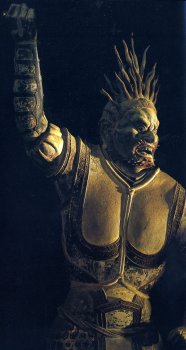 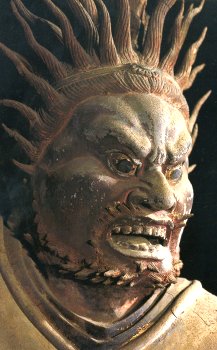
Agyō 阿形 (Also spelled Agyo)
One of the Nio, or Kongōrikishi 金剛力士
Standing, H = 326.3 cm., Hollow Dry Lacquer (Jp. = Dakkatsu Kanshitsu 脱活乾漆)
Tōdaiji Temple 東大寺, Nara Era. Photos by Ogawa Kōzō
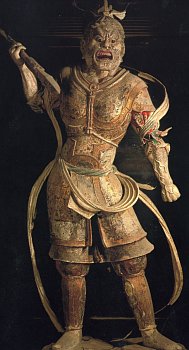 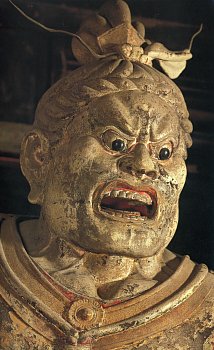
Shitsukongō-shin 執金剛神 and Closeup
Clay 塑像 with paint (saishiki 彩色), H = 173.9
Tōdaiji Temple 東大寺, Nara Era
Photos by Ogawa Kōzō
Says the Flammarion Iconograhic Guide: “These two guardian kings are Vajradharas (lit. holders of vajras, thunderbolt holders, called Shukongōshin 執金剛神 or Shukongōjin in Japan). Or they may be a type of Raksa (man-eating demons of Indian folklore). In Esoteric Buddhism, they represent two aspects of Vairocana (Dainichi Nyorai). In this respect, they are sometimes confused with the wrathful forms of Fudo Myoo and Aizen Myoo. Although similar to these latter forms, they are in fact distinct from them.” <end Flammarion quote> Site Editor’s Note: Shukongōshin is a rare, esoteric deity, in Japan. See JAANUS Shukongoshin entry for details.
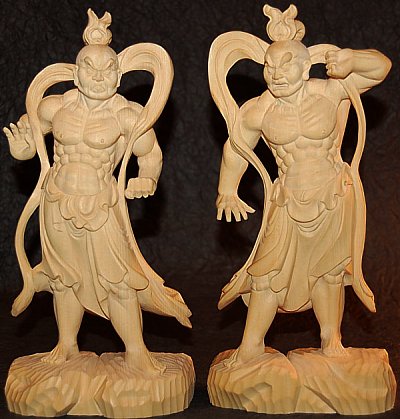
Nio Products in Our eStore

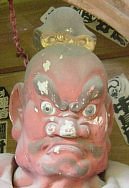 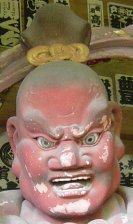
Above & Below
Ungyō 吽形 (L) Agyō 阿形 (R)
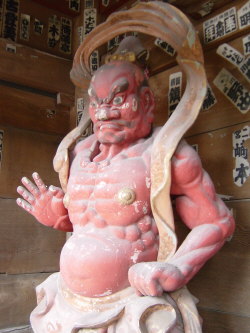
Sugimoto Dera, Kamakura, Date Unknown, Wooden Life size Statues
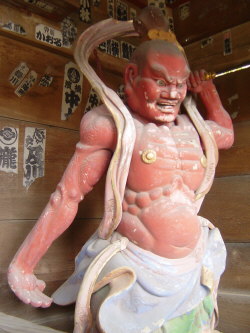 
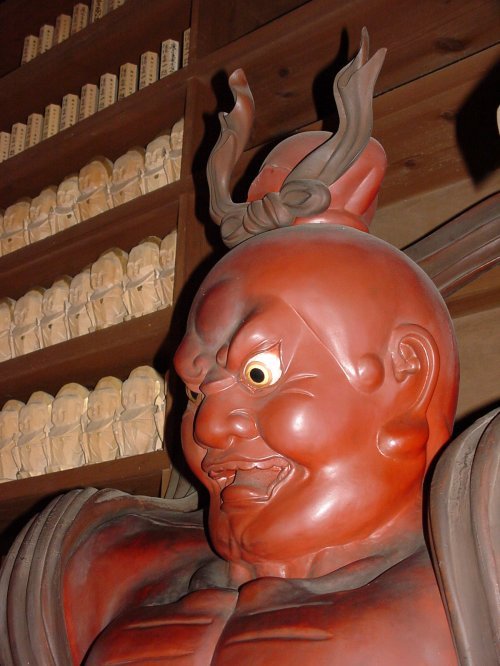
(L) Agyō 阿形 at Sugimoto Dera, Kamakura
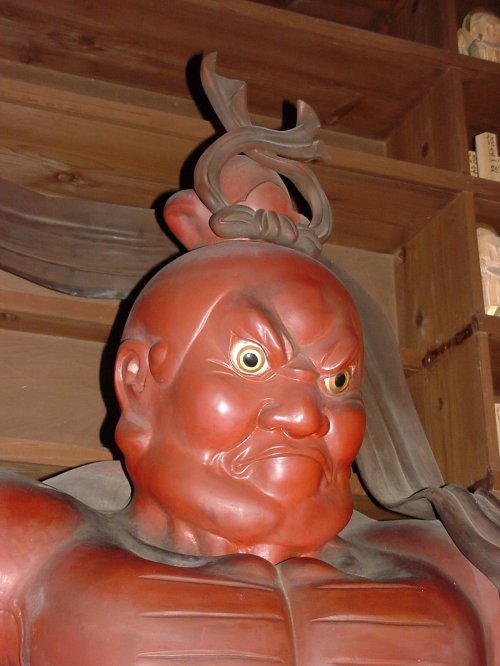
(R) Ungyō 吽形 at Sugimoto Dera, Kamakura
ABOVE PHOTOS: These two guardians at Sugimoto Dera in Kamakura protect the temple’s main treasure, a statue of the Kannon - Goddess of Mercy. Sugimoto is the first temple on the Bando Pilgrimage to 33 Sites Sacred to Kannon, and was established in the 9th century. Photos by Mark Schumacher.
Kongō Rikishi 金剛力士
Perhaps the most famous Niō pair can be found at the entrance gate of Tōdaiji Temple 東大寺 in Nara. The 26-foot-tall statues at Tōdaiji were made in 1203 AD, reportedly under the direction of the famous sculptors Unkei and Kaikei. They represent the Vajra god in two forms; one is masculine with mouth tightly closed; the other is feminine with mouth open. (Editor’s Note: need to determine if pair represents male and female forms)
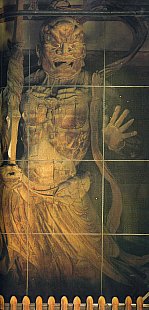 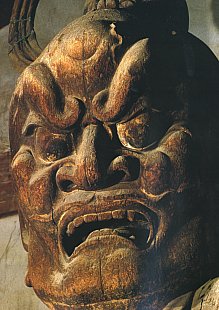
Agyō 阿形 H = 836.3 cm
Kongō Rikishi 金剛力士 (Kongou, Kongo)
Wood with Paint (Saishiki 彩色)
Made by the famous Kei school of sculptors.
(including Unkei and Kaikei) in the Kamakura Era.
Tōdaiji Temple 東大寺 (Toudaiji, Todaiji), Nara.
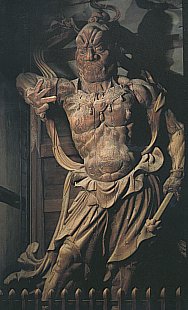 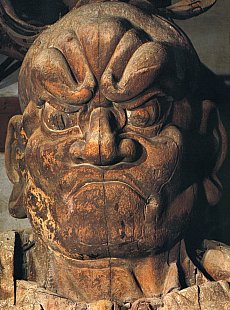
Ungyō 吽形 H = 842.3 cm
Kongō Rikishi 金剛力士 (Kongou, Kongo)
Wood with Paint (Saishiki 彩色). Made by the famous Kei school of sculptors.
(including Unkei and Kaikei) in the Kamakura Era. Tōdaiji Temple 東大寺, Nara.
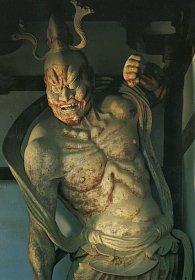 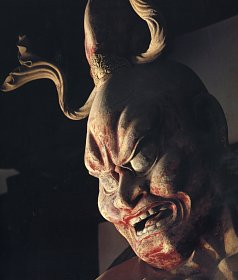
Agyō 阿形 H = 378 cm
Kongō Rikishi 金剛力士 (Kongou, Kongo)
Clay (sozō 塑像) with paint (saishiki 彩色)
Nara Era, 711 AD (Wadō Period Year 4)
Hōryūji Temple 法隆寺 in Nara
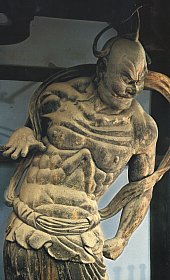 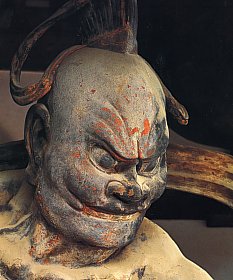
Ungyō 吽形 H = 375 cm
Kongō Rikishi 金剛力士 (Kongou, Kongo)
Clay (sozō 塑像) with paint (saishiki 彩色)
Nara Era, 711 AD (Wadō Period Year 4)
Hōryūji Temple 法隆寺 in Nara
Below text from Minneapolis Institute of Art www-artsmia.org
According to a Japanese story, there once was a king who had two wives. His first wife bore a thousand children who all decided to become monks and follow the Buddha's law. His second wife had only two sons. The youngest was named Non-o and helped his monk brothers with their worship. The eldest, Kongō Rikishi 金剛力士, however, had a much more aggressive personality. He vowed to protect the Buddha and his worshipers by fighting against evil and ignorance. Kongō Rikishi was the first of the heavenly kings, called Nio Niō (or Kongō). The second is called Shukongōshin 執金剛神. Within the generally pacifist traditions of Buddhism, stories of Niō guardians like Kongōrikishi justified the use of physical force to protect cherished values and beliefs against evil.
Other Naming Conventions
In Japan, the Niō guardian figures are named Misshaku Kongō 密遮金剛 (aka Agyō 阿形) and Naraen Kongō 那羅延金剛 (aka Ungyō 吽形). They represent the use of overt power and latent power, respectively. Naraen is also called Narayana (Sanskrit). Conceived as a pair, the Niō complement each other. Misshaku represents overt power, baring his teeth and raising his fist in action, while Naraen represents latent might, holding his mouth tightly closed and waiting with both arms tensed but lowered.
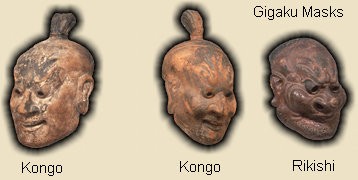
Gigaku Mask Photos courtesy GAKUGEKI KAMEN
Kongo: Open mouth, plus topknot.
Rikishi: Closed mouth, no topknot.
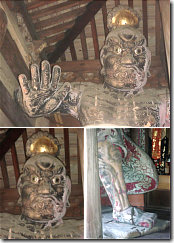 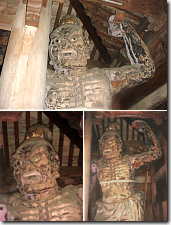
(L) Ungyō and (R) Agyō
Click any image above to see larger photo.
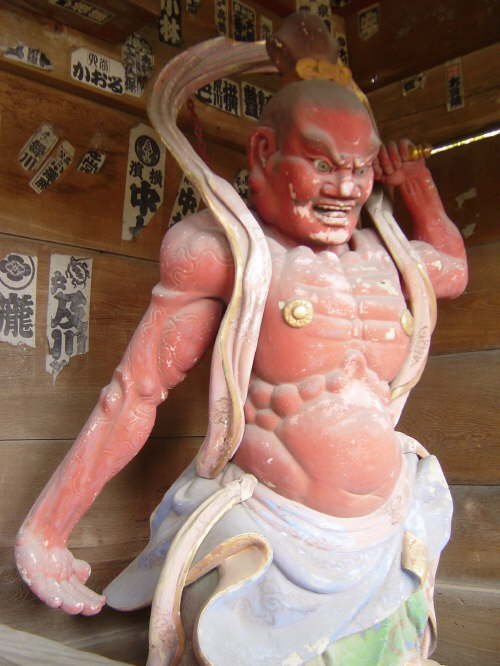
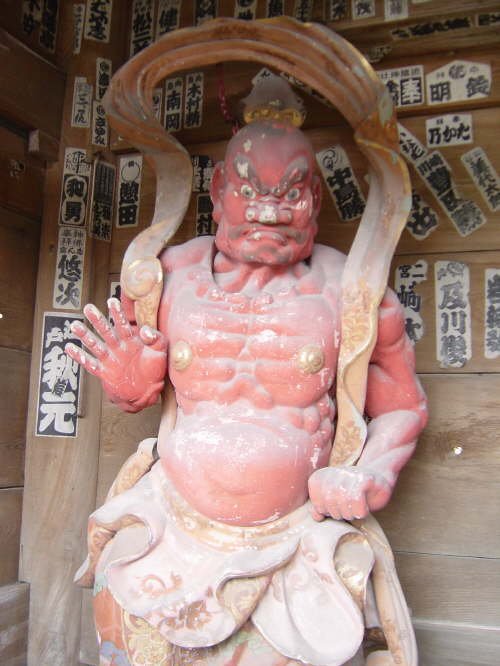
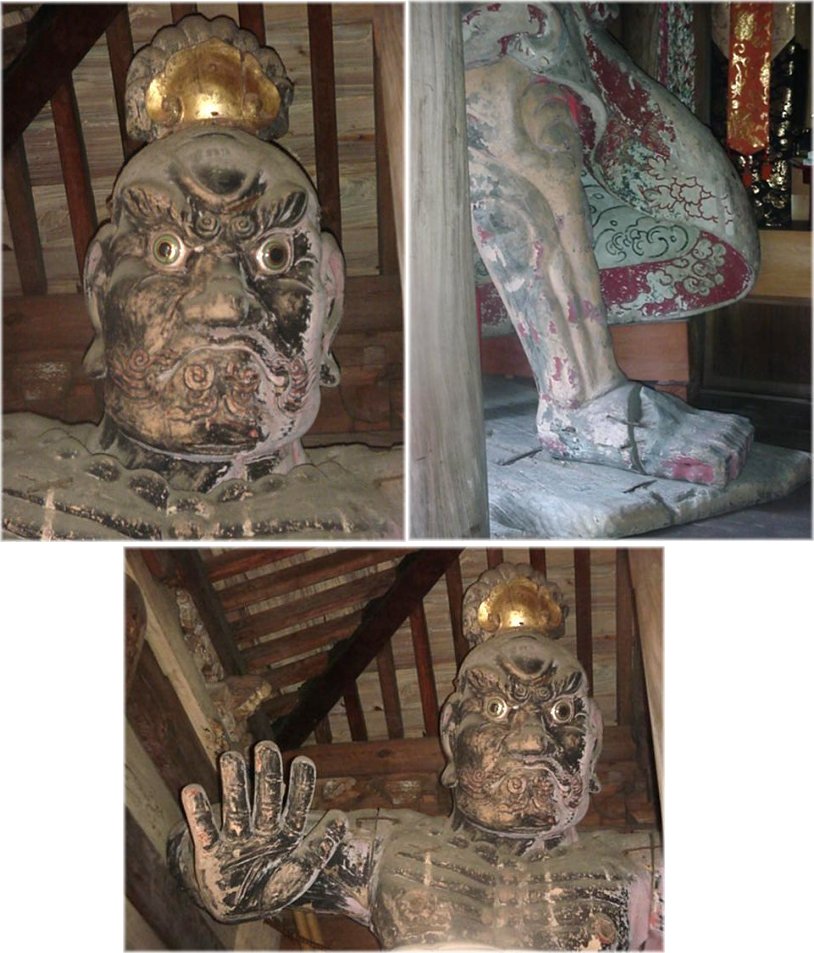
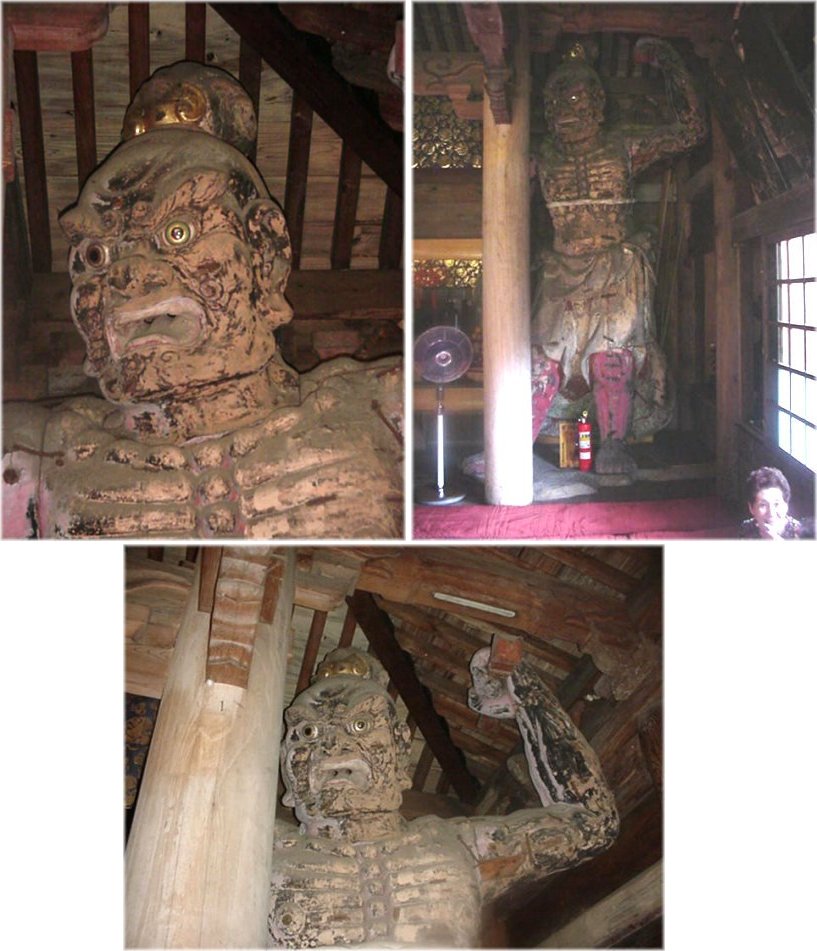
ABOVE: Wooden life-size statues at Jufukuji Zen Temple, Kamakura
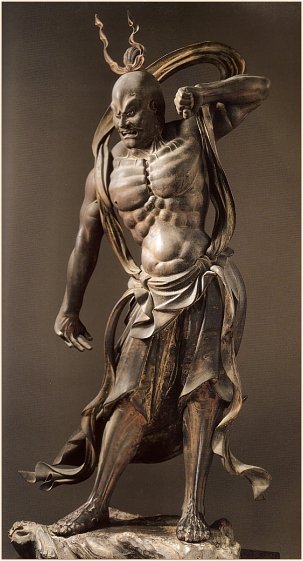
Agyō at Sanjūsangendō 三十三間堂, Kyoto
12th Century, Life-size Wooden Statue
Scanned from Temple Brochure
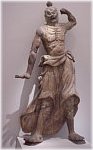
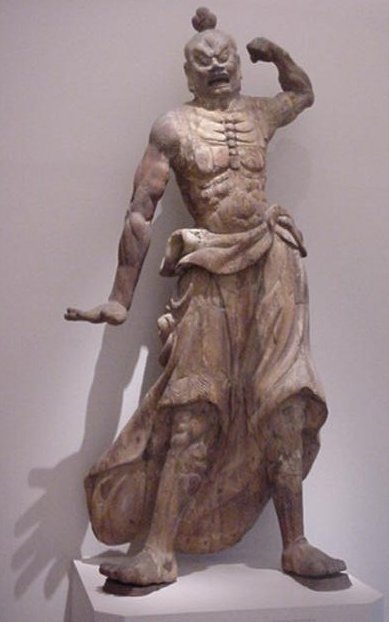
Agyō 阿形 (Click image to enlarge)
14th Century, Kamakura Era
Photo taken at Smithsonian, D.C.
Originally created to stand guard outside the entrance to
Ebaradera, a temple located in Sakai City, near Osaka
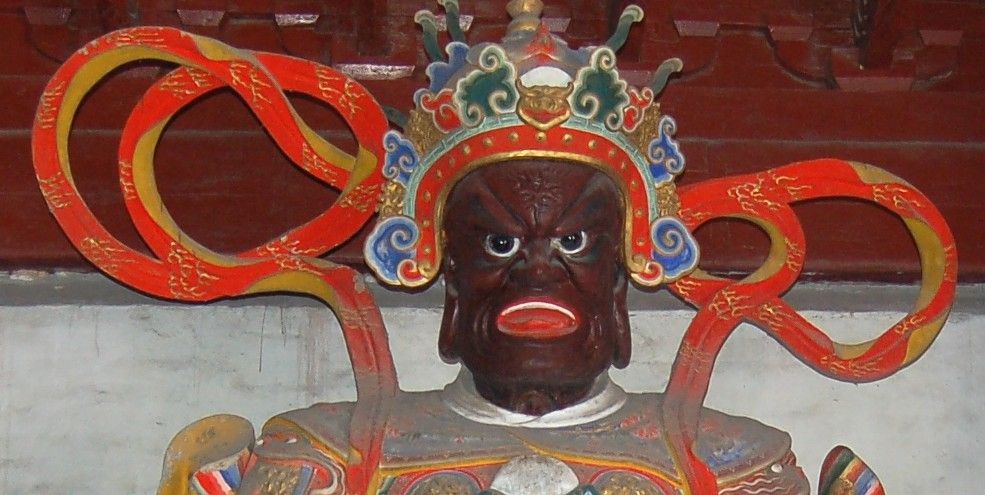
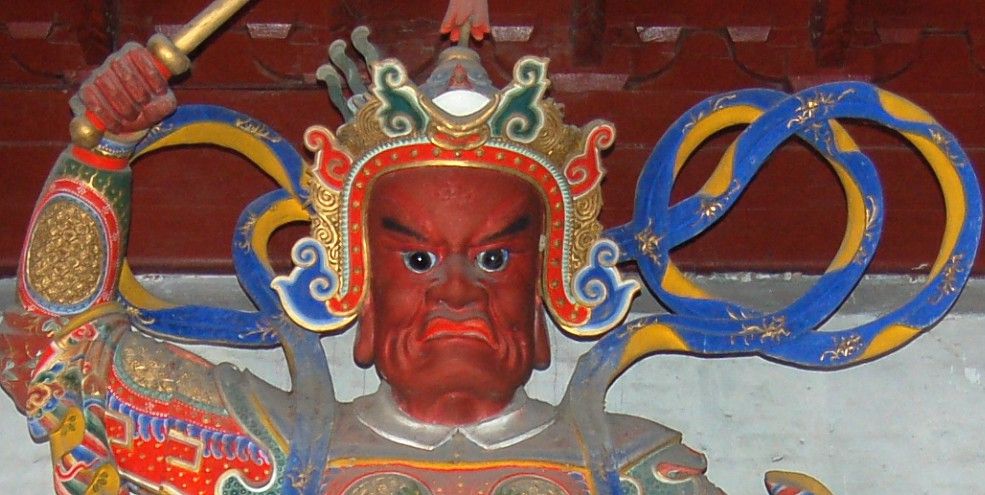
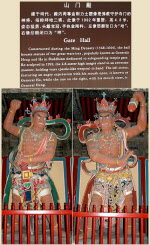
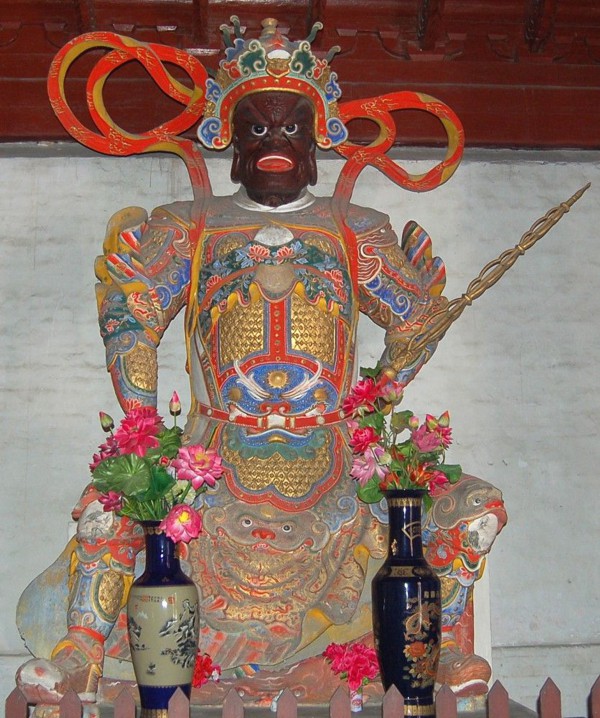
Chinese Door Gods, Generals Ha & Heng 哈哼二将
  a> a>  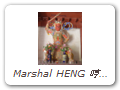
Click any image to enlarge
Marshals Ha 哈将 and Heng 哼将 protect the gates at many Chinese temples. Ha (the blower) has his mouth open, Heng (the snorter) has his shut. This "open-closed" iconography symbolizes duality (e.g., life and death, beginning and end, alpha and omega). It also represents the sacred Sanskrit term OM. These two marshals are unique to China, but their iconography can be traced back to two Buddhist deities known in Chinese as Rénwáng 仁王 (J = Niō, K = Inwang), translated as "benevolent kings" or "humane kings." These two kings are the Hindu vajra-dhara (vajra holders, vajra warriors). They were incorporated into Buddhism to protect and preserve the Buddhist teachings. Their fierce and threatening appearance is said to ward off evil spirits and keep the temple grounds free of demons and thieves. In some accounts, they were said to have followed and protected the Historical Buddha when he traveled throughout India. The Rénwáng commonly stand guard inside or outside the temple gates in China, Korea and Japan, one on either side of the entrance, one with mouth open, one closed. The open-mouth statue is typically placed to the right of the gate, the closed-mouth version to the left. In Japan, the temple gate itself is called the Niō-mon 仁王門 (Niō Gate). Marshals Ha and Heng are latecomers. In artwork, they first appear sometime in the Ming dynasty (1368-1644). Historically, they were two generals of the last emperor of the Shang dynasty (circa 1121 BC). HA is known as THE BLOWER, for he blew clouds of poisonous gas out of his mouth while defending the emperor. HENG is known as THE SNORTER, for he blew destructive light rays from his nose while protecting the realm.
|
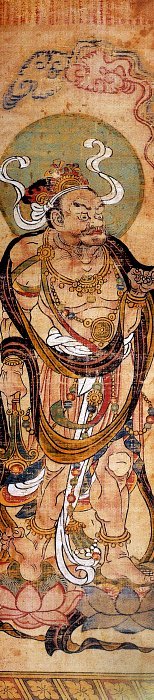
Vajrapani
Mogao Caves, Dunhuang
Tang Dynasty (9th C)
Ink and colors on silk
H = 72 cm, W = 17 cm
Palais du Louvre (Paris)
No. EO.1172b
Scanned from Book
ISBN 7-5054-0716-3/J-0396
|
|
 Vajrapani, Vajrāpani Vajrapani, Vajrāpani
Below text courtesy Jeff Watt
Watt-san is the Director of Himalayanart.org
Also Known as:
- Mahāsthāmaprāpta, Mahasthamaprapta, T = Phyag na rdo rje. NOTE: In Tibetan Buddhism, Mahāsthāmaprāpta (aka Seishi Bosatsu) is equated with Vajrāpani. In Tibet, Vajrāpani is considered an incarnation of Mahāsthāmaprāpta.
- Kongo Rikishi, same as Vajrapani
- Misshaku also known as Guhyapati
- Tibetan: Vajrapani is known as Sang wa'i dag po
Vajrapani (or Vajradara) means "thunderbolt holder" in Sanskrit. Vajrapani is the keeper of all tantras of Vajrayana Buddhism.
Kongorikishi is a Hindu god who has accepted to become a guardian of Buddhism. He frequently appears as two angry warriors at the gate of Japanese temples: Mitsushaku Kongo stands on the left and carries a thunderbolt stick while Naraen Kongo is on the right with a saber. The statues created by Unkei and Kaikei and located at the south main gate of Todaiji temple (Kyoto) are a master piece of Kamakura sculpture. Vajrapani or Vajradara means "thunderbolt stick holder" in Sanskrit.
Vajrapani, dark blue in colour with one face and two hands, appears in the form of a raksha (a daemon of classical Indian mythology) with three large staring eyes, a gaping mouth with bared canine teeth and orange beard, eyebrows and hair flowing upward like flame. The body is squat, large and fleshy. Adorned with a crown of five skulls with red pendants and gold earrings, bone necklace and bracelets, anklets, and a large green snake, he wears a long green scarf and a lower garment of tiger skin tied with a green sash. With the right leg bent and the left extended above a sun disc and multi-coloured lotus Vajrapani stands in the middle of the blazing fire of pristine awareness. Placed in front as an offering, framed by two ivory elephant tusks, an assortment of wishing jewels are arranged on a plain green landscape - painted in the style of Eastern Tibet.
At the top left is a seated buddha, yellow in colour with the right hand performing the mudra of ‘earth witness’ and the left placed in the mudra of meditation; seated in vajra posture above a moon disc and lotus. At the right is the deity of purification, Vajrasattva, white in colour with one face and two hands holding a vajra in the right held to the heart and with the left an upturned bell in the lap. Adorned with a crown, jewel ornaments and variously coloured silk garments he sits in the vajra posture above a moon disc and lotus seat.
Vajrapani represents the power aspect of complete enlightenment, and is known as Guhyapati (Tibetan: sang wa'i dag po). He is the ‘Lord of Secrets’ -- the keeper of all the tantras of Vajrayana Buddhism. As a bodhisattva, like Manjushri and Avalokiteshvara, he dwells on the 10th bodhisattva level just prior to attaining complete buddhahood. In actuality all three were completely enlightened aeons ago and only appear, for the sake of training others, in the guise of bodhisattvas. Vajrapani is common to all Schools of Tibetan Buddhism and has numerous forms and practices which span all sets of tantric classification and levels of complexity from a solitary aspect up to the large and complex mandala with many deities.
Above text written by Jeff Watt 7-98 (Jeff-san curates www.himalayanart.org).
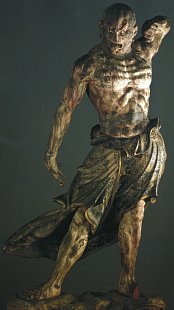 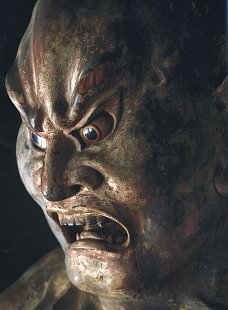
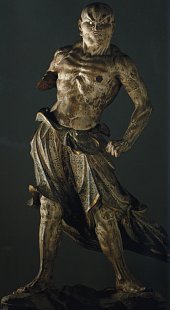
Agyō 阿形 Also known as Kongō Rikishi 金剛力士 (Kongou, Kongo)
Wood, with paint applied. H = 154 cm. Kamakura Era.
Kōfukuji Temple 興福寺. Scanned from Temple Brochure
 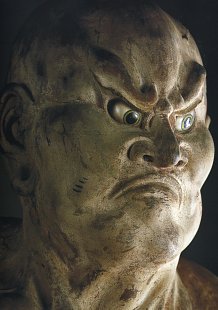
Ungyō 吽形 (Ungyo). Also known as Kongō Rikishi 金剛力士
Wood, with paint applied. H = 153.7 cm. Kamakura Era, Kōfukuji Temple 興福寺.
Scanned from Temple Brochure
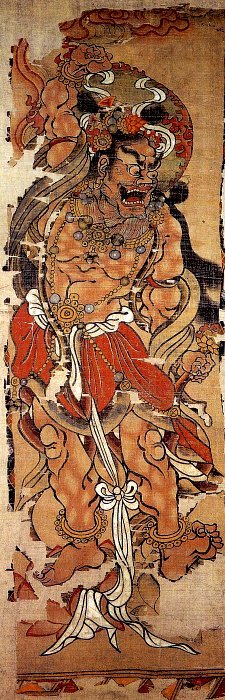
Vajrapani Painting at Mogao Hidden Library, Dunhuang, China
Power and anger personified. Late 9th Century, Tang Dynasty.
Ink and colors on silk. H = 79.5 cm, W = 25.5 cm. British Museum, Stein Painting 132.
Scanned from Book. ISBN 7-5054-0716-3/J-0396.
Special Niō Photo Tour
Longmen Caves (China), 5th to 10th Century
Photos by Schumacher, taken in Sept. 2008
Niō Statues at the Longmen Grottoes 龍門石窟 in China, plus a few from other locations. Longmen is located near Luoyang City, Henan Province, China. The Longmen Grottoes (lit. = Dragon Gate Grottoes) were designated a World Heritage Site in November 2000. The Longmen caves and cliff sculptures of Buddhist divinities are an outstanding example of China's artistic impulse to carve in stone. The grottoes and niches were created in phases over the centuries, with the oldest dating back to the late 5th century (Northern Wei Dynasty 386 - 534 AD), and the most recent completed in the 10th century (Tang Dynasty 618 - 907 AD). This long time span provides art historians and art lovers with a wonderous snapshot of China's changing artistic styles and the influence of India and Central Asia on China's Buddhist artwork. The grottoes are situated on both sides of the Yi River, and include some 2,300 caves and niches, more than 100,000 Buddhist images, and more than 2,800 inscriptions. Sadly, numerous statues were damaged in domestic anti-Buddhism campaigns in prior centuries, and most recently by massive looting and destruction between 1907 - 1938 by Chinese and foreigners alike. Many pieces found there way into museums in Germany, France, England, America, and Japan. The Chinese government continues to petition these nations and their museums for the return of said artifacts, but to no avail. Nonetheless, the Longmen Grottoes are still a wonder to behold. Many believe that Longmen represents the zenith of stone carving in China. It, along with the stone carvings found at Dunhuang 敦煌 (Mogao Caves 莫高窟) and at Datong 大同 (Yungang Grottoes 雲崗石窟), exemplifies the unrivavled beauty of cave art and cliff statuary in early China. (Simplified Chinese = 龙门石窟 Lóngmén Shíkū; Jp = 龍門 Ryūmon).
LEARN MORE
 Buddhist-Artwork.com, our sister site, launched in July 2006. Statues of the Nio are available in our online store, which sells quality hand-carved wooden Buddha statues and Bodhisattva statues, especially those carved for the Japanese market. It is aimed at art lovers, Buddhist practitioners, and laity alike. Just like this site (OnmarkProductions.com), it is not associated with any educational institution, private corporation, governmental agency, or religious group. Buddhist-Artwork.com, our sister site, launched in July 2006. Statues of the Nio are available in our online store, which sells quality hand-carved wooden Buddha statues and Bodhisattva statues, especially those carved for the Japanese market. It is aimed at art lovers, Buddhist practitioners, and laity alike. Just like this site (OnmarkProductions.com), it is not associated with any educational institution, private corporation, governmental agency, or religious group.
RESOURCES
- See Bibliography for our complete list of resources on Japanese Buddhism, or visit any site page and scroll to the bottom for detailed resources on that specific deity or topic.
- JAANUS (Japanese Architecture & Art Net Users System). Compiled by the late Dr. Mary Neighbour Parent; covers both Buddhist and Shinto deities in great detail and contains over 8,000 entries. See JAANUS NIO entry.
- A Dictionary of Chinese Buddhist Terms. With Sanskrit & English Equivalents. Plus Sanskrit-Pali Index. By William Edward Soothill & Lewis Hodous. Hardcover, 530 pages. Published by Munshirm Manoharlal. Reprinted March 31, 2005. ISBN 8121511453.
- Butsuzō-zu-i 仏像図彙, the “Collected Illustrations of Buddhist Images.” Published in 1783 (Genroku 元禄 3). One of Japan’s first major studies of Buddhist iconography. Hundreds of pages and drawings, with deities classified into approximately 80 (eighty) categories. Modern-day reprints are available at this online store (J-site).
- Digital Dictionary of Chinese Buddhism (C. Muller; login "guest")
- Nanzan Institute for Religion and Culture. Numerous online scholarly papers and its semi-annual Japanese Journal of Religious Studies.
- A History of Japanese Religion. Edited by Kazuo Kasahara. Kosei Publishing Company, 2002. Translated by Paul McCarthy and Gaynor Sekimori. 648 pages. Sixteen distinguished experts on Japanese religion approach the topic from modern perspectives. Topics range from prehistoric times up until the early postwar years. Click here to read review of book by scholar Paul L. Swanson.
- Buddhism: Flammarion Iconographic Guides, by Louis Frederic, Printed in France, ISBN 2-08013-558-9, First published 1995. A highly illustrated volume, with special significance to those studying Japanese Buddhist iconography. Includes many of the myths and legends of mainland Asia as well, but its special strength is in its coverage of the Japanese tradition. Hundreds of accompanying images/photos, both B&W and color. A useful addition to your research bookshelf.
- Sculpture of the Kamakura Period. by Hisashi Mori, from the Heibonsha Survey of Japanese Art. Published jointly by Heibonsha (Tokyo) & John Weatherhill Inc. A book close to my heart, this publication devotes much time to the artists who created the sculptural treasures of the Kamakura era, including Unkei, Tankei, Kokei, Kaikei, and others. ISBN 0-8348-1017-4. 1st Edition 1974.
- Says JAANUS about Shukongōshin 執金剛神. Also read Shuukongoujin. Also called Kongoushu 金剛手, Jikongou 持金剛, Kongou Rikishi 金剛力士 (Skt: Vajrapani or Vajradhara). Buddhist guardian deity who wears armor and holds a pestle-like club, (Skt: vajra, Jp: kongousho 金剛杵). His fierce-looking face with glaring eyes, wide-open mouth and threatening pose identify him as a suitable guardian of the Buddha. Shukongoushin may derive from Devadatta, a cousin of the Buddha who served as his body guard. The deity is also related to the Hindu god Indra (Jp: Taishakuten 帝釈天) who is associated with thunderbolts and has his own origin in the folk deity Yaksa (Yasha 夜叉) who was a gate guardian. Shukongoushin's protective function is often fulfilled between two figures called Kongou Rikishi or the Niou 仁王. The 9c NIHON RYOUIKI 日本霊異記 (collection of Buddhist tales) compiled by Keikai 景戒 tells of a miraculous statue of Shukongoushin which aided the priest Rouden 良弁 (also known as Roben, 689-773), who was the second patriarch of the Kegon 華厳 sect in Japan and who worked on the construction of Toudaiji 東大寺 . The famous clay statue (sozou 塑造) of Shukongoushin at the Sangatsudou 三月堂 (also known as Hokkedou 法華堂), Toudaiji, which dates from the mid 8c, has long been considered the same as that mentioned in literature. The late 15c handscroll of the "Legends of Shukongoushin" Shukongoushin-engi emaki 執金剛神縁起絵巻, Toudaiji, illustrates the legends associated with the deity.
NOTEBOOK
- UNGYO -- JAPANESE SHINGON MANTRA FOR
吽なまさまんだば さらなん けいあびもきゃ まかはらせんだきゃなや
きんじらや さまや まさや まなさんまら そわか
Unnamasamandaba Saranan Keiabimokya Makaharasendakyanaya
Kinjiraya Samaya Masaya Manasanmara Sowaka
- AGYO -- JAPANESE SHINGON MANTRA FOR
阿なまさまんだば さらなん とらだりせい まかろしゃな きゃなやさるばだたあぎゃたねん くろそわか
Anamasamandaba Saranan Toradarisei Makaroshana Kyanayasarubadataagyatanen Kurosowaka
|
|





 a>
a>