|
|
Handbook on Viewing Buddhist Statues
A totally wonderful
book by Ishii Ayako.
Some images
at this site were
scanned from this
book; Japanese
language only;
192 pages;
80+ color photos
Click here to
buy book at Amazon
|
|
JIKOKUTEN 持國天
King of the East, Guardian of the Nation, Kingdom Keeper
Associations = East, Strength, Spring, Water, Green / Blue
ORIGIN = Hindu deity incorporated into Buddhism.
Member of the TENBU, SHITENNŌ, DEVA
One of Four Heavenly Kings Who Guard East, West, North, South
Governed by Taishakuten (Skt. = Indra), Lord of the Center
|
Japanese Mantra
おん ぢりたらしゅたら
らら はらまだな そわか
On Chiritara Shutara
Rara Haramadana Sowaka
Also read: Om Chiritara Shutara
Rara Haramadana Sowaka
|
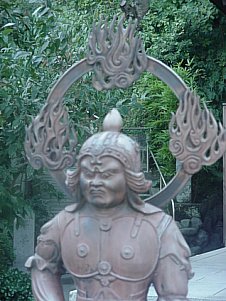
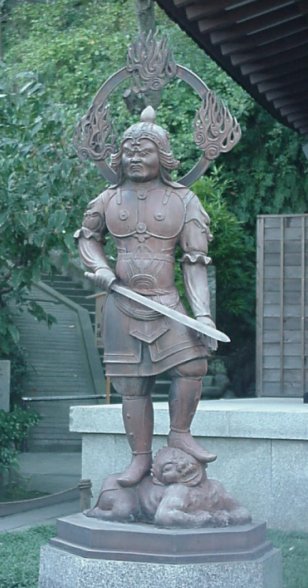
Jikokuten at Hase Dera, Kamakura.
Modern, Metal. Click image to enlarge.
|

Sanskrit Seed
for Jikokuten
Pronounced CHIRI
in Japan
|
JIKOKUTEN 持國天 literally means “Guardian of the Nation.” Jikokuten is the Keeper of the Kingdom, the Upholder of the Country, the Protector of the World. Jikokuten usually carries a sword in right hand, with closed left hand resting on hip; sometimes shown holding a stringed instrument or playing a lute (which harkens to the Middle Way -- strings break if too tight, but if too slack, no sound is produced). Said to command an army of Kendatsuba (Skt. = Gandharva; celestial musicians) and Bishasha (Skt. Pisaca; vampire demons). As the Buddhist protector of the eastern quarter, Jikokuten is similar to the dragon of Chinese mythology. The colors & symbols associated with Jikokuten vary according to country and sect.
VARIOUS SPELLINGS & ASSOCIATIONS
- Japanese = Jikokuten 持國天.
- Skt. = Dhṛtarāṣṭra, Dhrtarasta, Dhrtarastra, Dhritarashtra.
- Chn. = Chíguó Tiān, Ch'ih-kuo T'ien.
- Korean = 지국천, Jiguk cheon, Chiguk ch'ŏn.
- Vietnam = Trì quốc thiên.
- Tibet = Yul Khorsung
- East, Spring, Water, Strength, Green / Blue (White in India and China).
- King of the East, Guardian of the Nation. Keeper of the Kingdom.
- Dwells in and protects the eastern continent Tō Shōshin Shū 東勝身洲 (Skt. = Pūrva-videhaḥ) surrounding Mt. Shumisen 須弥山 (Skt. = Mt. Sumeru). This mountain is the mythical home of the Historical Buddha and other deities).
- Rules over the Kendatsuba (Skt: Gandharva; scent eaters, celestial musicians) and Bishasha 毘舍遮 (Skt. = Piśācī, Pisaca; vampire demons, female sprites).
- Appears in the eastern portion of the Gekongōbu-in 外金剛部院. (outer section) of the Taizōkai Mandala 胎蔵界曼荼羅 (Womb World, Matrix Realm).
- Appears in various other mandala, including the Ten Realms Mandala and Hōrōkaku Mandala.
- In the Nichiren sects, Zōchōten is #13 on the Gohonzon 御本尊 diagram.
- Nearly always dressed in armor (yoroi 鎧), looking ferocious (funnusō 忿怒相), and carrying weapons or objects (jimotsu 持物) said to eliminate evil influences and suppress the enemies of Buddhism. Also typically shown standing atop evil spirits (known as Jaki in Japan), symbolizing the power to repel and defeat evil. Sometimes depicted with a fiery halo.
- Often depicted wearing a helmet (kabuto 兜) and weilding a sword or three-pronged spear (sansageki 三叉戟). But Jikokuten’s attributes are not rigidly prescribed and differ among Buddhist nations.
- Oldest extant statue of Jikokuten is part of a set of four Shitennō statues possessed by Hōryūji Temple 法隆寺 in Nara that dates to the mid-7th Century. See photo below.

|
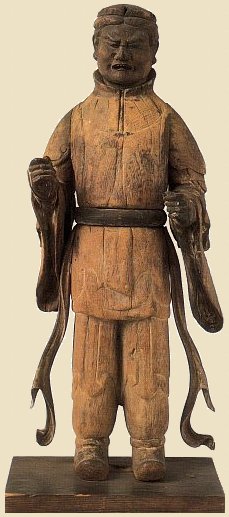
Jikokuten (Dhratarastra), Plain wood, 50.3 cm
Asuka Era, 7th Century, Hōryūji Temple 法隆寺, Nara
|
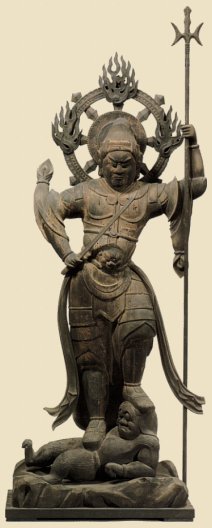
Jikokuten (Dhrtarastra), 93 cm, Wood with Pigments
Heian Era, 11-12th century, Hōryūji Temple 法隆寺, Nara
|
|
|
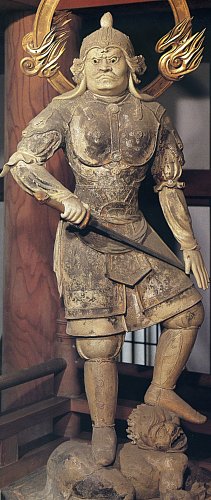
Jikokuten (East)
Nara Era, 8th Century, Painted Clay, H = 152.4cm
Tōdaiji Temple 東大寺 (Nara)
|
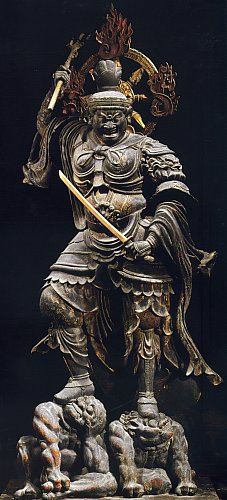
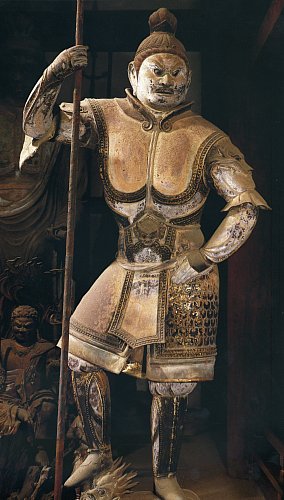
Jikokuten (East)
Wood, Heian Era, 839 AD, Painted Wood, H = 183 cm
Toji Temple 東寺, Photo: 日本の仏像, Vol. 4
|
|
|
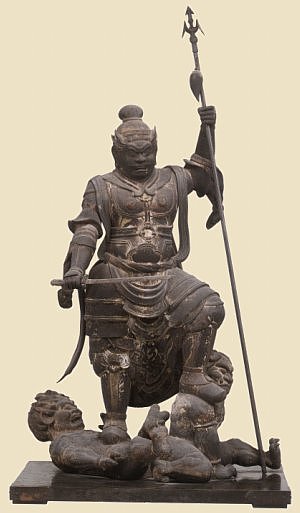
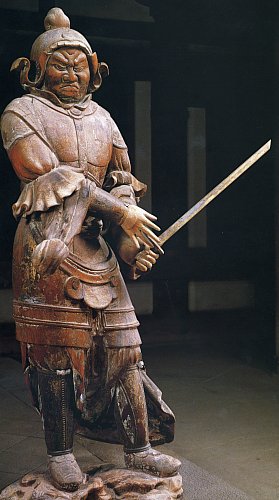
Jikokuten (East)
Heian Era, 11th Century
Wood, H = 110 cm
Hōryūji (Horyuji) Temple 法隆寺 in Nara
Scanned from temple catalog
|
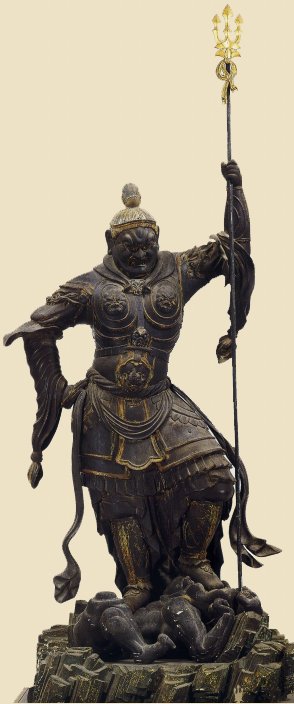
Jikokuten (East)
Early Kamakura Era, Wood
Tōdaiji (Todaiji) Temple 東大寺in Nara
Photos scanned from 日本仏像 Vol. 10
|
|
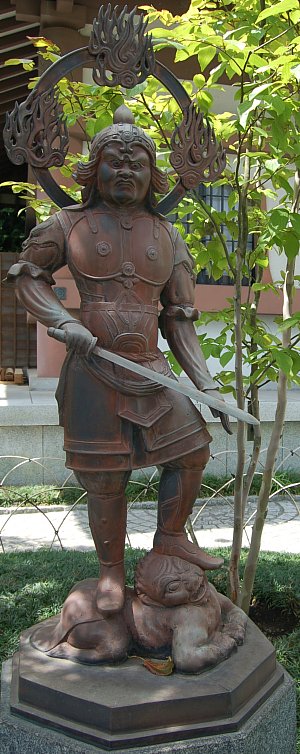
Jikokuten (East)
Modern Metal Statue, Hase Dera Temple in Kamakura
|
|
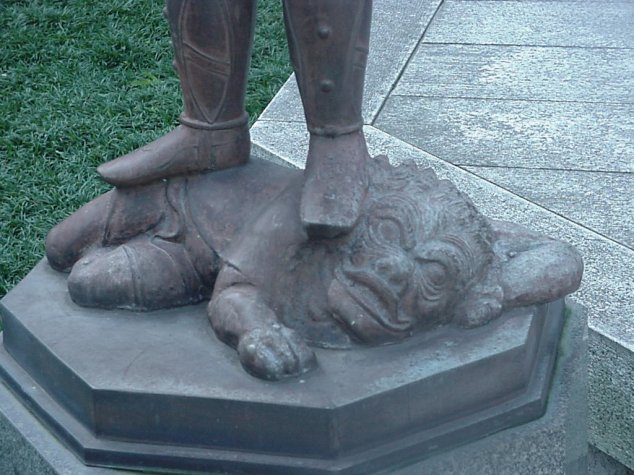
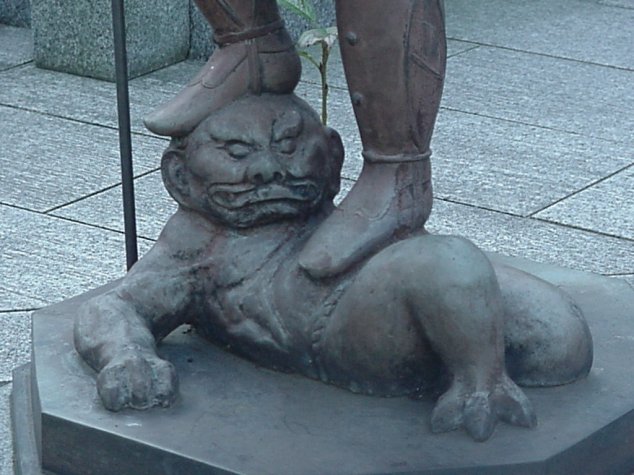
JYAKI (JAKI) DEMON - 邪鬼
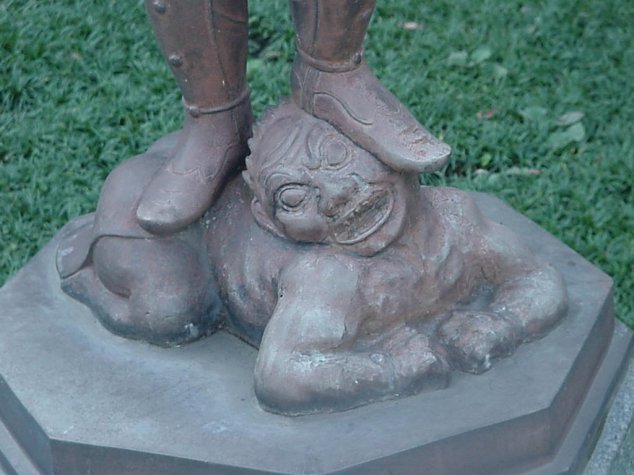
In Japan, the Four Shitennō Guardians are almost always shown stepping on evil demons called Jyaki or Tentōki. This iconography symbolizes the power of the Shitennō to repel and defeat evil.
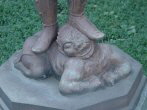 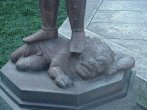 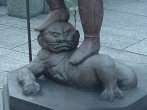
Jaki (Jyaki) at Hase Dera in Kamakura (click any image to enlarge)
Click here for more details about the Jyaki demons.
|
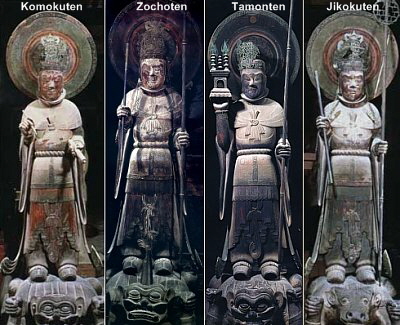
Four Shitennō, Hōryūji Temple 法隆寺, Nara
Mid-7th Century. Oldest extant set of the four.
Kōmokuten 広目天, Zōchōten 増長天, Tamonten 多門天, Jikokuten 持国天
Painted Wood, Each Statue Approx. 133.5 cm in Height
Photos from Comprehensive Dictionary of Japan's Nat’l Treasures
国宝大事典 (西川 杏太郎. ISBN 4-06-187822-0.
|
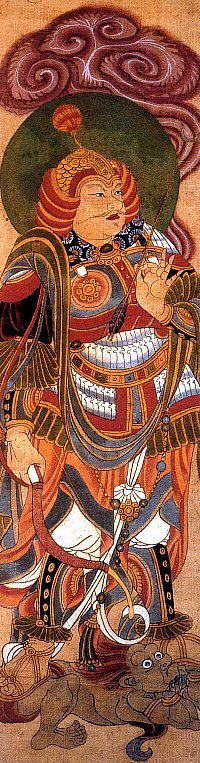
Jikokuten (East)
Chinese = C = Chíguó Tiān
Tang Dynasty, Ninth Century
H = 72 cm, W = 17 cm
Ink and colors on silk.
Palais du Louvre in Paris
No. EO.1172a
Paintings from the Hidden
Library Cave, Dunhuang, China.
Scanned from
“DUNHUANG: A Centennial
Commemoration of the Discovery
of the Cave Library.”
ISBN 7-5054-0716-3/J-0396.
First published in 2000
by Morning Glory Publishers,
Beijing, China
|
|
 LEARN MORE LEARN MORE
- Buddhist-Artwork.com, our sister estore, offers statues of the Shitennō.
- Shitennō, Four Heavenly Kings. Four Deva Kings. Guardians of East, West, North, South (the four cardinal directions). The Shitennō are also associated with four legendary creatures of Chinese mythology (dragon, red bird, tiger, turtle). See Shijin (Four Celestial Emblems) for more on these four creatures.
- In the Japanese Mandala, the Shitennō (Guardians of the Four Directions) are typically shown, from the top, starting with the eastern guardian. Thus, the typical order is Jikokuten (East), Zōchōten (South), Kōmokuten (West), and Tamonten (North).
- 28 Constellations, 28 Moon Lodges, 28 Moon Stations (this site)
Learn more about each of the four quarters (north, south, east, west) and the seven constellations in each group. All 28 represent points in the moon’s monthly path, and each was deified.
- Butsuzō-zu-i 仏像図彙, the “Collected Illustrations of Buddhist Images.” Published in 1690. One of Japan’s first major studies of Buddhist iconography. Hundreds of pages and drawings, with deities classified into approximately 80 (eighty) categories. Modern-day reprints of the expanded Meiji-era version are available at this online store (J-site).
- Mandara Zuten 曼荼羅図典 (Japanese Edition). The Mandala Dictionary. 422 pages. First published in 1993. Publisher Daihorinkaku 大法輪閣. Language Japanese. ISBN-10: 480461102-9. Available at Amazon.
- JAANUS. Japanese Architecture & Art Net Users System. Compiled by the late Dr. Mary Neighbour Parent; covers both Buddhist and Shintō deities in great detail and contains over 8,000 entries.
- A Dictionary of Chinese Buddhist Terms. With Sanskrit & English Equivalents. Plus Sanskrit-Pali Index. By William Edward Soothill & Lewis Hodous. Hardcover, 530 pages. Published by Munshirm Manoharlal. Reprinted March 31, 2005. ISBN 8121511453.
- Digital Dictionary of Chinese Buddhism (C. Muller; login "guest")
- Buddhism: Flammarion Iconographic Guides, by Louis Frederic, Printed in France, ISBN 2-08013-558-9, First published 1995.
- 4 Heavenly Kings, Great Mandala Study Group (outside link). Also see Four Heavenly Kings, Nichiren Tradition (outside link). “They appear in the ceremony of the Lotus Sutra with their 10,000 retainer gods in the Dharani (26th chapter). Therein, Jikokuten and Bishamonten pledge on behalf of all four to protect those who embrace the Lotus Sutra.
- Four Heavenly Kings (J-site, outside link), plus Sanskrit characters used herein.
- See Bibliography for our complete list of resources on Japanese Buddhism
|
|
|