|
 THIS IS A SIDE PAGE THIS IS A SIDE PAGE
Return to Main Kannon Page or
Return to Pilgrimage Guide
KAMAKURA PILGRIMAGE
TO 33 SITES SACRED TO KANNON
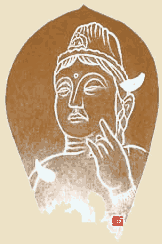
KANNON BOSATSU 観音菩薩 (Skt. Avalokitesvara)
GODDESS OF MERCY; Origin India
Help for People in Distress in Earthly Realm
According to the Lotus Sutra, Kannon appears in 33 different manifestations to alleviate the suffering of all living beings. Although the Kamakura Pilgrimage does not feature statues from all 33 manifestations, there are nonetheless 33 old and famed temples sacred to Kannon in Kamakura. It has long been believed that visiting all 33 sites is an act of great merit. The following is the order of the Kamakura 33 Kannon Pilgrimage, which was probably established sometime in the Edo era (1603-1868). See 100 Kannon Pilgrimages Nationwide for more details.
KAMAKURA PILGRIMAGE TO 33 SITES SACRED TO KANNON
Multi-site Pilgrimages. The multi-site format of the Kannon Pilgrimage is one of the most prevalent pilgrimage formats in Japan. Multi-site circuits involve a number of sacred places linked together numerically, with each location devoted to the same single deity or to a group of related deities. This is known as honzon junrei 本尊巡礼 — literally to wander around (jun) to worship (rei) the principle deity (honzon). In order to complete the pilgrimage, participants are obliged to visit every single site on the circuit. Each site is equally important and none serve as the center or definitional locus. Although the sites are assigned numbers, participants can visit them in any order (the only prerequisite is that “all” are visited). The numbers indicate the most convenient route for those who are unfamiliar with the circuit’s logistics. Multi-site pilgrimages need not be completed in a fixed timeframe. Instead, participants can perform the circuit in multiple journeys spread out over any length of time. In bygone times, pilgrims often wore special pilgrimage garments. Today most wear everyday clothes and carry a book (nōkyō-chō) that can be purchased at any site along the route. This book is then stamped (for a small fee) at each site visited. These stamps (shu-in) are often very artistic, but their main function is to serve as a testimony to the pilgrim’s completion of the journey.
Why Number 33 ? The Kannon Sutra (chapter 25 of the Lotus Sutra) mentions 33 specific forms of the Kannon. But it is unclear why the number 33 was used. One theory relates to the Buddhist realm Mt. Shumisen 須弥山 (Skt. = Mt. Sumeru, Mt. Meru) from Hindu mythology. In this heavenly palace of the Buddha and all followers, there are 33 deities who guard and protect the realm. They are commanded by Taishakuten (Skt. = Indra), who governs the other 32 gods who live on the 32 peaks of Sumeru, eight in each of the four directons. Taishakuten’s palace is known as Zenkenjō 善見城 (Palace of Correct Views); also called Kikenjō (Joyful to See), located in the Buddhist heaven called Trayastriṃśas (Skt.) atop Mt. Shumisen. Also, probably related to the 32 realms of Vedic mythology and to the 32 Marks of the Buddha. The Shitennō (Four Heavenly Kings) live halfway down the four sides of Mt. Shumisen, the mythical home of Shakya Nyorai (Historical Buddha). According to Buddhist lore, Mt. Shumisen is found at the center of the universe, surrounded by eight mountain ranges, and in the ocean between the 7th and 8th there are four continents inhabited by humans. These four continents are protected by the Shitennō, with each leading an army of supernatural creatures to keep the fighting Ashura at bay. On the top of Mt. Shumisen is the heavenly palace of Shakya Nyorai, and the abode of the Trayastrimsha (33 Gods) ruled by Taishakuten, who commands the Shitennō.
Other 33 Kannon Pilgrimages. In Japan, there are numerous 33-site pilgrimage circuits sacred to Kannon. Among the best known are the Saigoku Pilgrimage to 33 sites (Kansai area), the Bandō Pilgrimage to 33 sites (Kanto area), and the Chichibu Pilgrimage to 34 sites (Saitama Valley). Together these 100 nationwide sites are extremely sacred to Kannon, and completing the circuit to each is said to save the believer from hell and to open the gates to everlasting life. The 33 forms of Kannon given in the Lotus Sutra are the basis for these pilgrimage circuits. For those who cannot spare the time, miniature circuits (wherein pilgrims can visit 33 images within a single temple compound, like that at Ishiyamadera) are available. In all these pilgrimages, the forms of Kannon don’t match the 33 forms of the Lotus Sutra, but instead feature popular Kannon manifestations such as the 1000-Armed Kannon, the 11-Headed Kannon, the Nyoirin Kannon, and the Shō Kannon.
Buddhism for the Common Folk. The three deities Amida, Kannon, and Jizō, became especially popular among the common folk during the Kamakura Period, and today remain the bedrock of folk Buddhism. Amida for the coming life in paradise, Kannon for salvation in earthly life, and Jizō for salvation from hell. See From Court to Commoner Buddhism in the Kamakura Era.
This is a Side Page
Return to Main Kannon Page
or Return to Pilgrimage Guide
|





