|
|
|
|
This is a Side Page.
Return to the Main HOTEI Page.
Hotei
by Jennifer Polden (Univ. of Wisconsin-Eau Claire)
www.uwec.edu/philrel/shimbutsudo/hotei.html
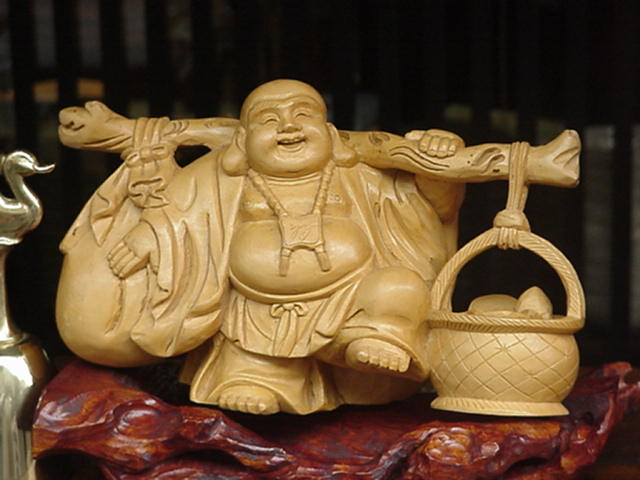
Hotei is one of the Seven Lucky Gods of Japan. He is known as the God of Happiness, a patron of children, fortunetellers, bartenders, and politicians. According to Juliet Piggott, author of The Beliefs & Deities of Japan, his appearance is of a big, fat, bald man. He is often smiling and has bristly whiskers around his face. The fat stomach, which protrudes from the robes he wears, symbolizes the largeness of his soul. Reiko Chiba, author of The Seven Lucky Gods of Japan, adds that he is also seen carrying a large bag over his shoulder that is said to contain gifts and fortunes for those who believe in his virtues.
Hotei stands out from the other six Lucky Gods because he is the only one known to have been a real person, rather than a mythical being. According to Chiba, his Chinese name was Kaishi. His birth date is unknown, but his date of death was in March of the year 916. He was a Zen priest who could quote Buddhist text verses almost nonstop. Some sources affirm that he was an incarnation of the Bodhisattva Miroku (Maitreya in Sanskrit), the Buddhist Savior of the Future (Giraud 404). However, some of his actions would not be considered particularly saintly. For example, he would beg for meat and fish even though they were foods forbidden to priests. Presumably, he thought it unnecessary to abide by the restrictions that lesser mortals need to guide their lives. Hotei also looked like a rogue and had no regular place to stay or sleep. It is said that once he slept outside during a snowstorm, and people were amazed when he did not get cold or wet (Chiba 21).
According to legend, Hotei is also a fortuneteller whose predictions always come true. The only catch is that he will not tell the future to any person who does not sincerely affirm a desire to know the complete truth (Chiba 21). Sometimes, they may end up regretting their excessive curiosity.
Hotei is often shown surrounded by a group of small children, romping and squealing in delight around his rotund shape. In addition, he has a reputation for giving gifts. There is a tradition, credited by many, that if a group of strangers gather together on New Year's Eve and ask Hotei for the same gift, provided they have strength of will and truly believe that he will grant it, Hotei will indeed give them what they ask for (Chiba, 22). Another custom is to place a drawing of Hotei, shown in a treasure boat along with the six other Lucky Gods, under one's pillow on the first night of January. The idea is to ensure that one's first dream of the new year will be an auspicious one.
Sources
- Chiba, Reiko. The Seven Lucky Gods of Japan. Tokyo, Japan: Charles E. Tuttle Company, 1996.
- Guirand, Felix, Ed. New Larousse Encyclopedia of Mythology. Prometheus Press, 1972.
- Piggott, Juliet. The Beleifs and Deities of Japan. London: Hamlyn Publishing Group, 1969.
|
|
|