|
Avalokitesvara is possibly the most popular of all
Buddhist deities, beloved throughout the Buddhist world. The word
avalokita means “observes the sounds of the world” and
isvara means “lord”. The full name has been variously interpreted
as “the lord who hears/looks in every direction” and “the lord of hearing
the deepest”. The great vow of Avalokitesvara is to listen to the
supplications from those in difficulty in the world and to postpone his
own Buddhahood until he has helped every being on earth achieving
enlightenment. Therefore, he is treated as the embodiment of all the
Buddhas' compassion, the lord of infinite compassion in Mahayana Buddhism.
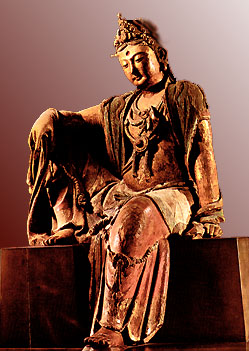 Avalokitesvara is also an emanation of
Amitabha’s compassion and with Amitabha’s figure represented in his
headdress. He guards the world in the interval between the departure of
the historical Buddha, Sakyamuni, and the appearance of the future Buddha,
Maitreya. Based on scriptures of the Pure Land school that were translated
into Chinese between the 3rd and 5th centuries, the Pure Land sect
practitioner look to rebirth in the Western Paradise of the Buddha
Amitabha, Avalokitesvara forms part of a ruling triad, along with Amitabha
and the bodhisattva Mahasthamaprapta. Images of the three are often placed
together in temples. Avalokitesvara is also an emanation of
Amitabha’s compassion and with Amitabha’s figure represented in his
headdress. He guards the world in the interval between the departure of
the historical Buddha, Sakyamuni, and the appearance of the future Buddha,
Maitreya. Based on scriptures of the Pure Land school that were translated
into Chinese between the 3rd and 5th centuries, the Pure Land sect
practitioner look to rebirth in the Western Paradise of the Buddha
Amitabha, Avalokitesvara forms part of a ruling triad, along with Amitabha
and the bodhisattva Mahasthamaprapta. Images of the three are often placed
together in temples.
According to the Chinese Tantric (Mi-tsung) school from
Tang Dynasty, Avalokitesvara’s ability to assume innumerable forms that
has led to thirty-three major representations. The following nine
representations are the most famous ones. Among them the first seven has
later become the famous Seven Avalokitesvara in Japanese Tantric (Shingon)
school:
(1) Sahasrabhuja (Senju), the 1,000 armed figure;
(2) Ekadasamuhka (Ju-ichi-men), the 11 faced with
2-or 4-handed figure;
(3) Cintamani cakra (Nyo-i-rin), the seated
figure, with 6 arms, holding the wish-fulfilling jewel.
(4) Amoghapasa (Fuku-kenjaku), the one with lasso
and net, a form popular with the Tendai sect;
(5) Hayagriva (Ba-to), the one with a fierce face
and a horse's head in the hairdress;
(6) Cundi (Jun-tei), the seated figure with 18
arms, the mother goddess;
(7) Aryavalokitesvara (Sho), the sacred, simple
form;
(8) Palasambari (Ye-I), the one with leaf clothes,
with 2 or 4 arms;
(9) Pandurarasini (Bai-I), the one with white
clothes, with 2 arms;
Avalokitesvara's worship was introduced into China (as
Kuan-yin) as early as the 1st century AD. Representations of
the bodhisattva in China prior to the Sung dynasty (960–1126) were
masculine in appearance. Later images displayed attributes of both genders
is believed to be accordance with the Lotus Sutra where Avalokitesvara has
the ability of assuming whatever form is required to relieve suffering and
also has the power to grant children. Also because this bodhisattva is
considered a mother-goddess, the representation in China has further
interpreted in all female form around the 12th century. However soft
contours of the body seen in statues and paintings have been intentionally
combined with a visible moustache to emphasize the absence of sexual
identity. The sacred site of Kuan-yin is the island of Pu-To (Mountain)
near Ning-Po City (associated with the traditional mountain residence of
the bodhisattva Potala). 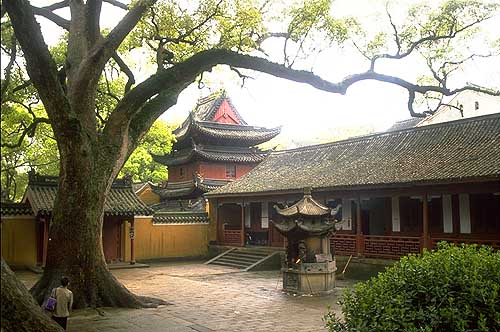
Kuan-yin's worship probably reached Japan (called
Kannon) by way of Korea soon after Buddhism was first
introduced into the country from the mid-7th century. The worship of the
bodhisattva was never confined to any one sect and continues to be
widespread throughout Japan.
This bodhisattva was introduced into Tibet (called
Chenresig- With a Pitying Look) in the 7th century, where he
quickly became the most popular figure and successively reincarnated in
each Dalai Lama. The most famous Tibetan mantras - om mani padmehum,
translated as “the jewel in the lotus”, is credited with Avalokitesvara’s
introduction to Tibet. In Tibet his images are frequently placed on
hilltops. In Mongolia Avalokitesvara is called Nidü-ber üjegci (He Who
Looks With the Eyes). The title used for him in Indochina and Thailand is
Lokesvara (Lord of the
World). |